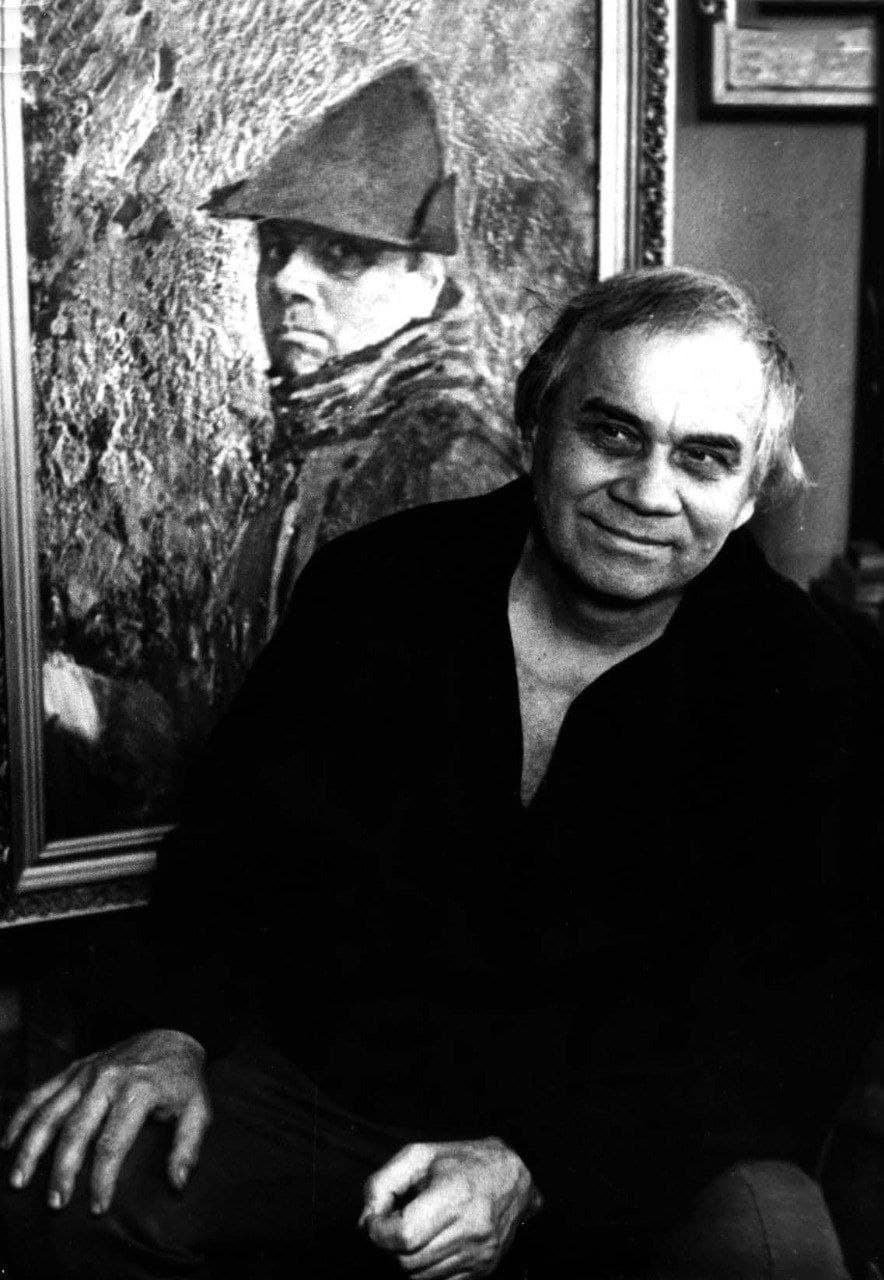
Viktor Zaretskyi
Віктор Зарецький
1925–1990 · Bilopillia, Sumy Oblast, Ukraine
Viktor Zaretskyi (1925–1990) was a Ukrainian painter, monumentalist and teacher, husband of Alla Horska and one of the leaders of the Sixtiers generation. After beginning with a socially observant Donbas miners' cycle he turned in the 1980s to an ornamental, gold-laden manner indebted to the Vienna Secession that earned him the nickname "the Ukrainian Klimt".
Viktor Ivanovych Zaretskyi was born on 8 February 1925 in Bilopillia in what is now Sumy Oblast. He studied at the Kyiv Art School from 1946 and at the Kyiv State Art Institute (1947–1953) under Kostiantyn Yeleva, Mykhailo Sharonov and Serhii Hryhoriev, and taught at the institute until 1957. In 1952 he married the painter Alla Horska; their studio on Filatov Street in Kyiv became a meeting point for the Sixtiers, and from 1963 Zaretskyi chaired the Club of Creative Youth "Suchasnyk". His early Donbas canvases — «Зміна» (1955), «Шахтарський двір» (1958) — take the miners' world as subject while pressing beyond the conventions of Socialist Realism. Through the 1960s he worked with Horska, Halyna Zubchenko, Hryhorii Synytsia, Borys Plaksii and others on monumental mosaics in Donetsk, Kyiv, Mariupol and Krasnodon, several of which have since been damaged or destroyed. Horska's murder in November 1970 — her body was found in the cellar of Zaretskyi's father's house in Vasylkiv — marked him permanently; he returned to her in works such as «Василь Стус» (1971) and «Пам'яті Алли Горської» (1989–1990). From 1978 he ran a private studio with more than two hundred students, among them Arsen Savadov, and set out his teaching in the text "Reflections beside the Canvas". In the early 1980s he became absorbed in the art of the Vienna Secession and especially Gustav Klimt, producing the gilded, decoratively patterned late paintings for which he is best known, alongside the triptychs «Мистецтво» and «Релігія» (1987) and «Голодомор» (1988). He died of pancreatic cancer on 23 August 1990 in Koncha-Ozerna near Kyiv and was awarded the Taras Shevchenko National Prize posthumously in 1994. He left roughly a thousand paintings and drawings.
Art Movements
Monumentalism
Monumentalism is an architectural and artistic approach emphasizing grand scale, durability, and intense symbolism, designed to evoke awe and project authority or historical significance. It often features austere, symmetrical, and geometric forms crafted from permanent materials like stone or concrete, frequently used to promote political, state, or civic power. Key Characteristics Colossal Scale: Focuses on immense size to dominate the landscape. Permanence & Stability: Utilizes materials intended to last for centuries. Symbolic Power: Commonly used to glorify specific regimes, ideologies, or historical events. Simple Aesthetics: Often features geometric shapes, strong symmetry, and simplified, austere, and massive structures.
Explore movement →Social Realism
Social Realism is an international art movement—spanning painting, photography, literature, and film—that emerged in the mid-19th century and peaked in the 20th century to expose the harsh socio-political conditions of the working class. It functions as a critical, unidealized depiction of poverty, labor struggles, and structural inequality to challenge power structures. Key Characteristics and Context Purpose: To draw attention to the everyday hardships of the poor and working classes, often functioning as a critique of capitalist, industrial, or governmental systems. Origin: The movement grew from 19th-century French and Russian realism, reacting against romanticism and bourgeois art styles. Resurgence: It thrived between the World Wars and during the 1930s Great Depression, particularly in the U.S. and Mexico, focusing on themes of labor, community, and resilience. Style: It emphasizes subject matter over form, often using a descriptive, gritty, and direct visual language.
Explore movement →1880s–1910sSymbolism
A late nineteenth- and early twentieth-century movement that turned away from the documentary aims of realism toward myth, allegory, dream and inner experience. In Ukraine it arrived through Kyiv, Poltava, Kharkiv and Lviv art circles and through artists trained in Munich, Paris and St Petersburg, and it fed directly into Ukrainian Art Nouveau and early modernism. Ukrainian symbolists favoured antique and folk mythology, ritual and allegorical figure compositions over contemporary social subjects.
Explore movement →mid-1950s – 1970sSixtiers (Shistdesiatnyky)
A generation of Ukrainian artists, writers and intellectuals who emerged during the post-Stalin Thaw and pushed back against imposed Socialist Realism by reconnecting with Ukrainian folk form, Byzantine and Cossack-era sources, and European modernism. Centred in Kyiv on the Club of Creative Youth 'Suchasnyk' (founded 1959–62), the circle included Alla Horska, Opanas Zalyvakha, Halyna Sevruk, Liudmyla Semykina and Veniamin Kushnir. Most were expelled from official structures, blacklisted or imprisoned after the 1965 and 1972 waves of arrests, and much of their work was destroyed or hidden until the late 1980s.
Explore movement →20th century – presentMosaic Art
Art made by assembling images from small fragments of glass, smalt, ceramic or stone. In Ukraine the medium ranges from the monumental smalt panels of the Soviet-era public-building programme to contemporary independent and street practice, where artists mount mosaic panels directly on facades and interiors. Since 2022 a distinct wartime strand has appeared in front-line cities, with artists composing mosaics from window glass shattered by Russian strikes and returning the finished works to the sites of the damage.
Explore movement →Works by Viktor Zaretskyi
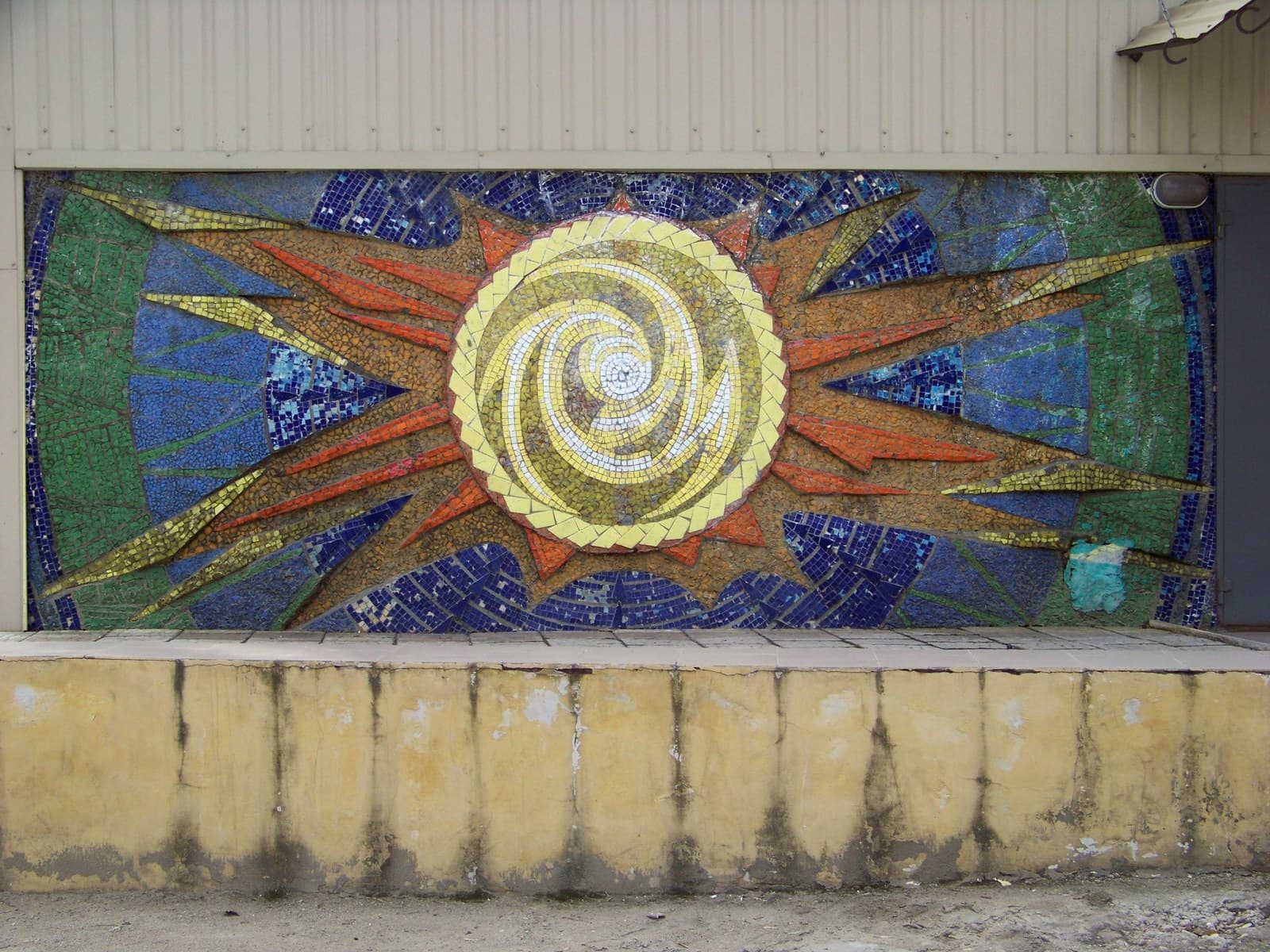
Prometheuses, Earth, Fire (mosaics of School No. 5, Donetsk)
Zaretskyi's contribution to the nine-panel mosaic cycle made in 1965–1966 by a collective led by Hryhorii Synytsia with Alla Horska, Halyna Zubchenko and Hennadii Marchenko. The central «Прометеї» panel sets two figures raising a flame among cosmic spirals and folk-ornament suns; the cycle fuses Ukrainian folk decoration, Baroque and Mexican muralism.
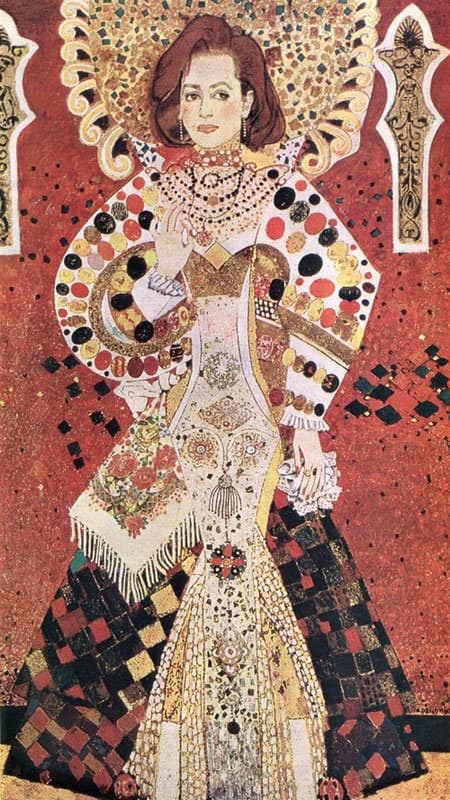
Portrait of the People's Artist of the Ukrainian SSR Tetiana Tsymbal
A late portrait from the period in which Zaretskyi absorbed the Vienna Secession, the sitter set against a flattened field of gilded ornament in the manner that earned him the nickname "the Ukrainian Klimt".