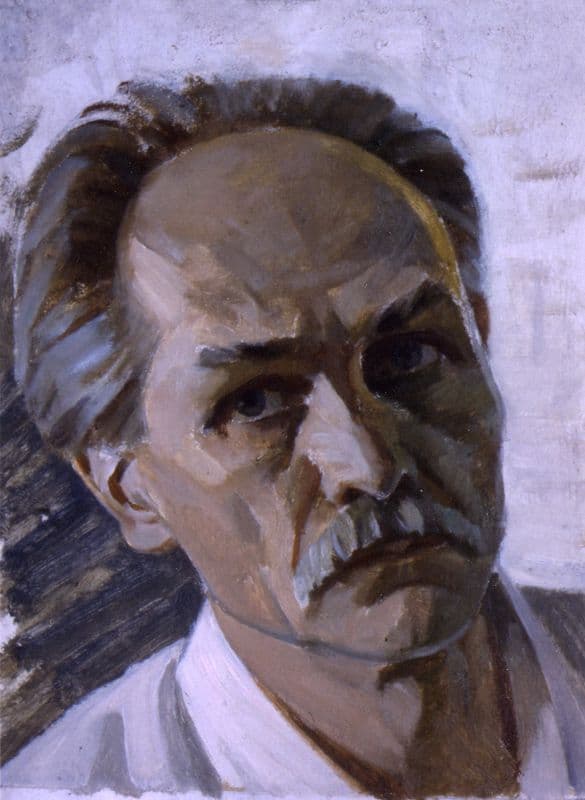
Veniamin Kushnir
Веніамін Володимирович Кушнір
1926–1992 · Kupyn, Kamianets-Podilskyi district (now Horodok district), Khmelnytskyi region, Ukraine — per the Encyclopedia of Modern Ukraine; Ukrainian Wikipedia instead gives Rudka, Dunaivtsi district, in the same region
Veniamin Kushnir was a Ukrainian painter and monumentalist, and one of the founders of the Kyiv Club of Creative Youth 'Suchasnyk' that gave the Sixtiers movement its centre. He fused Carpathian and Podillian folk form with modernist colour in paintings of motherhood, horses, musicians and Hutsul landscape, and was pushed to the margins of official art for his Ukrainian national convictions.
Veniamin Volodymyrovych Kushnir was born on 7 January 1926 in Podillia (Kupyn per the Encyclopedia of Modern Ukraine, Rudka per Ukrainian Wikipedia — both in today's Khmelnytskyi region). He studied monumental and decorative painting at the Lviv Institute of Applied and Decorative Art from 1948 to 1953 under Roman Selskyi, Yosyp Bokshai and Ivan Hutorov, an unusually modernist training for the period. After teaching at the Dnipropetrovsk Art School (1953–55) he moved to Kyiv in 1956 and, around 1959–62, became a founder and the head of the artists' section of the Club of Creative Youth 'Suchasnyk', the crucible of the Ukrainian Sixtiers; his close circle included Alla Horska, Opanas Zalyvakha and Halyna Sevruk. His subjects were Ukrainian motherhood ('Mothers', 1972), horses, kobzars and rhapsodes, Hutsul life in the Carpathians (the Dzembronia series, 1962) and the landscape of Podillia, treated with flattened folk-derived drawing, heavy contour and saturated tempera and oil colour. 'Trembita' (1961) and 'Red Poppies' (1961) were read at the time as statements of national feeling, and after the crackdowns of the 1960s and 1970s he was largely shut out of official exhibitions, working on smaller formats in cardboard and tempera. From the late 1980s he produced a series of sharply political pictures — 'Emancipation' (1989), 'Rally' (1990), 'The Artist and the General' (1990) — as well as the late self-portraits, including 'Self-Portrait with a Candle' (1991). He died in Kyiv on 19 June 1992; his widow Halyna Vozna-Kushnir went on to lead the initiative that created Kyiv's Museum of the Sixtiers, which holds one of his self-portraits, and a retrospective at the Dukat gallery in 2016–17 brought his work back into public view.
Art Movements
Monumentalism
Monumentalism is an architectural and artistic approach emphasizing grand scale, durability, and intense symbolism, designed to evoke awe and project authority or historical significance. It often features austere, symmetrical, and geometric forms crafted from permanent materials like stone or concrete, frequently used to promote political, state, or civic power. Key Characteristics Colossal Scale: Focuses on immense size to dominate the landscape. Permanence & Stability: Utilizes materials intended to last for centuries. Symbolic Power: Commonly used to glorify specific regimes, ideologies, or historical events. Simple Aesthetics: Often features geometric shapes, strong symmetry, and simplified, austere, and massive structures.
Explore movement →Modernism
Modernism was a radical, early-to-mid-20th-century cultural movement that broke with traditional artistic, literary, and social forms to align with a rapidly industrializing world. Characterized by experimentation, abstraction, and individualism, it sought new modes of expression to address themes of alienation and social change following World War I. Rejection of Tradition: Modernists rejected Victorian morality, academic art, and realistic depictions of subjects, seeking to "make it new". Experimentation: A shift towards abstraction in art (e.g., Cubism) and new techniques in literature, such as stream of consciousness (e.g., Virginia Woolf, James Joyce). Key Themes: Focused on subjectivity, alienation, the fragmentation of reality, and the quest for new meaning. Architecture & Design: Marked by minimalism, functionalism, and the use of industrial materials, famously summarized by Le Corbusier’s "a building is a machine for living in". Time Period: Roughly 1890s–1960s, emerging in Europe and America as a response to urbanization and technological advances.
Explore movement →Folk Decorative Art
Folk decorative art is the visual language of a community, traditionally created by untrained artisans rather than academic artists. It combines utility with ornament, transforming everyday objects like furniture, textiles, and tools into works of cultural expression.
Explore movement →mid-1950s – 1970sSixtiers (Shistdesiatnyky)
A generation of Ukrainian artists, writers and intellectuals who emerged during the post-Stalin Thaw and pushed back against imposed Socialist Realism by reconnecting with Ukrainian folk form, Byzantine and Cossack-era sources, and European modernism. Centred in Kyiv on the Club of Creative Youth 'Suchasnyk' (founded 1959–62), the circle included Alla Horska, Opanas Zalyvakha, Halyna Sevruk, Liudmyla Semykina and Veniamin Kushnir. Most were expelled from official structures, blacklisted or imprisoned after the 1965 and 1972 waves of arrests, and much of their work was destroyed or hidden until the late 1980s.
Explore movement →Works by Veniamin Kushnir
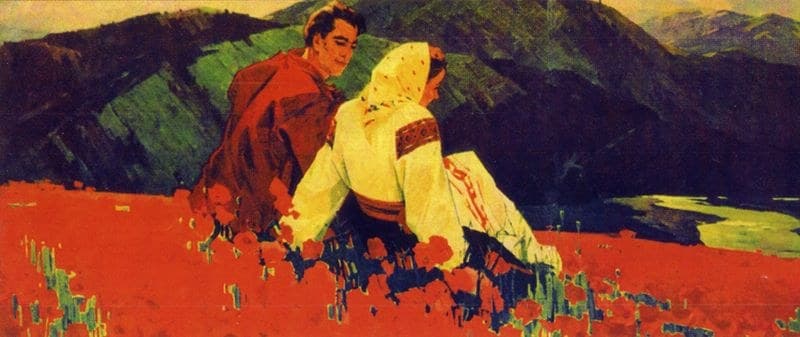
Red Poppies
One of the two 1961 canvases, alongside 'Trembita', that established Kushnir's reputation among the Sixtiers, its blazing red poppies read at the time as an unmistakable statement of Ukrainian national feeling.
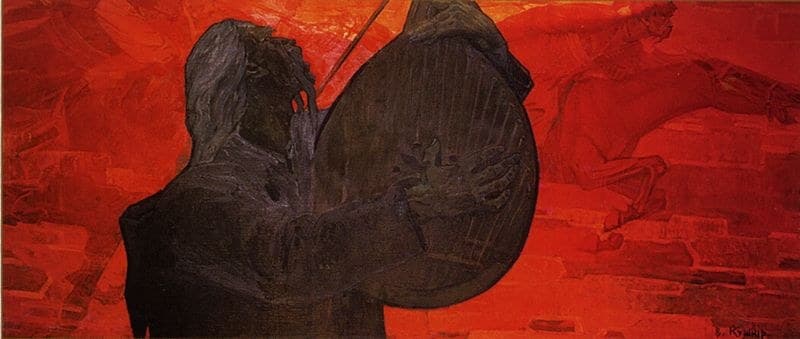
Kobza
A kobzar with his instrument, one of Kushnir's recurring images of the blind wandering singer as bearer of Ukrainian memory, drawn in the flattened, contour-led manner he took from folk painting.
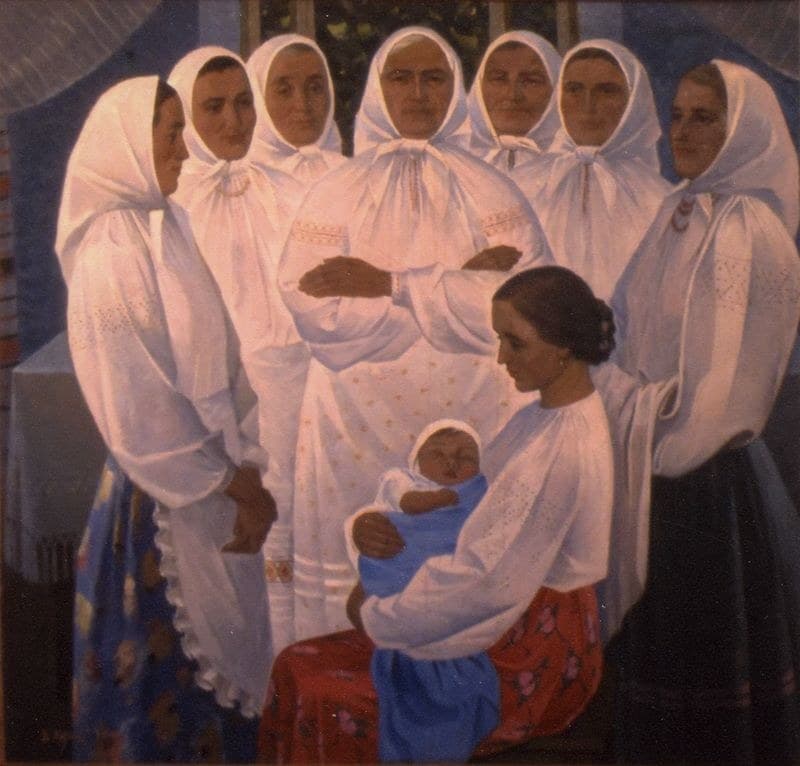
Mothers
A group of Ukrainian mothers rendered as near-iconic, monumental figures — the central work in the cycle on motherhood that runs through Kushnir's painting from the 1960s onward.
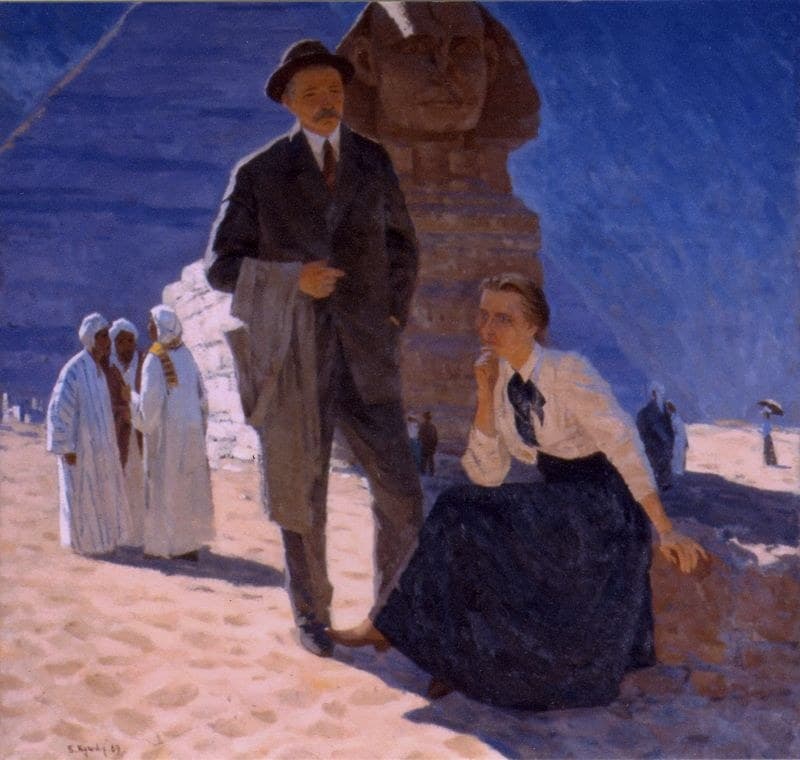
Lesia Ukrainka in Egypt
A late imagined portrait of the poet Lesia Ukrainka during her convalescent travels in Egypt, painted as the Soviet system was collapsing and Kushnir's work turned openly to Ukrainian cultural heroes.
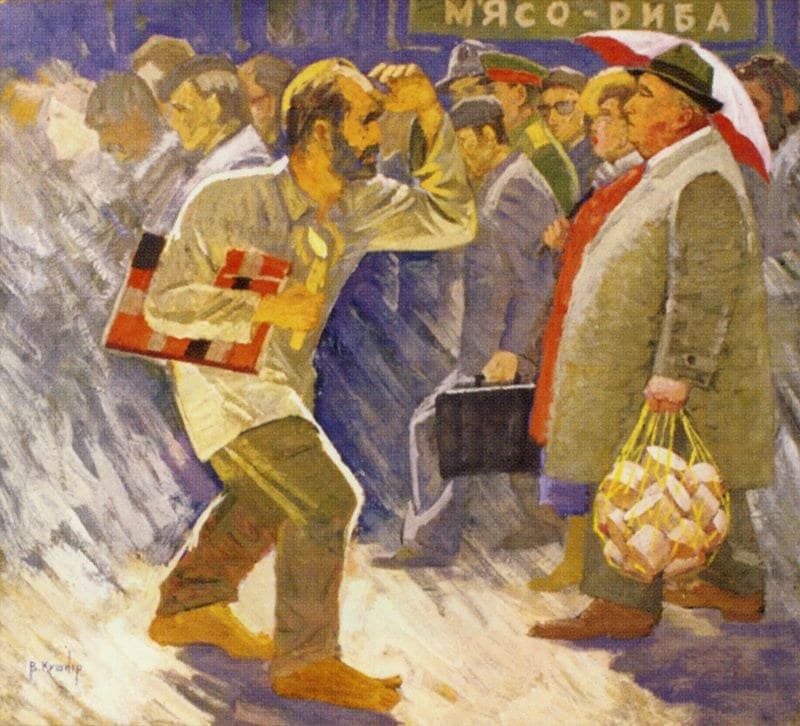
Self-Portrait with a Candle
Kushnir's last self-portrait, painted the year before his death and the year of Ukrainian independence: the artist lit by a single candle, a summing-up of a career spent largely outside official art.