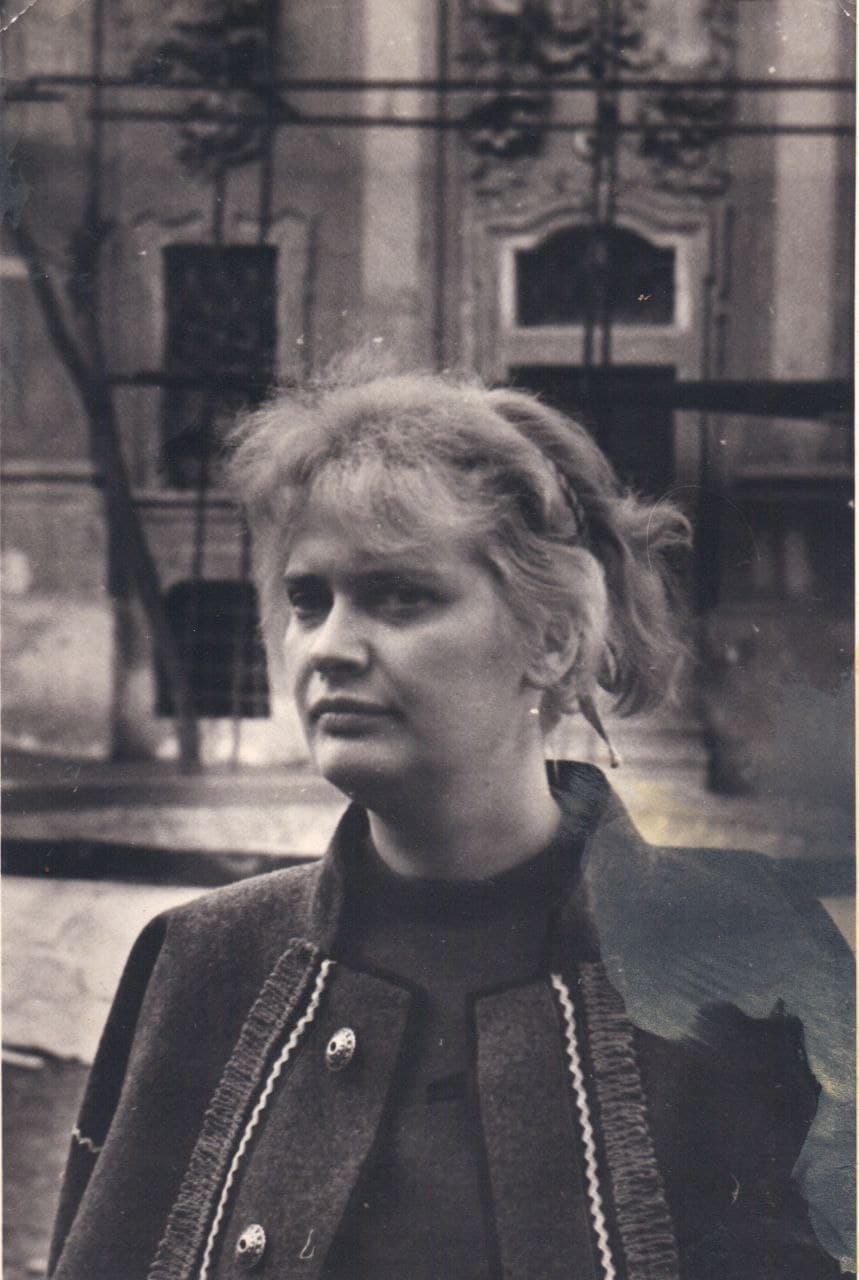
Alla Horska
Алла Горська
1929–1970 · Yalta, Crimea
Alla Horska (1929–1970) was a Ukrainian painter and monumentalist, and with her husband Viktor Zaretskyi a founder of the Club of Creative Youth "Suchasnyk" and a central figure of the Sixtiers and the dissident movement. Her output spans easel painting and portrait drawing, banned stage designs for Les Taniuk, and large mosaic and stained-glass cycles. She was murdered in Vasylkiv in November 1970 at the age of 41, and much of her monumental work has since been destroyed or is endangered.
Alla Oleksandrivna Horska was born on 18 September 1929 in Yalta and grew up in Kyiv. She finished the Kyiv Art Secondary School with a gold medal in 1948 and graduated from the Kyiv State Art Institute in 1954 from the studio of Serhii Hryhoriev; in 1952 she married a fellow student, Viktor Zaretskyi. Raised in a Russian-speaking family, she learned Ukrainian as an adult with the help of the activist Nadiia Svitlychna. Between 1961 and 1965 she was one of the organisers of the Club of Creative Youth "Suchasnyk", which became the centre of Ukrainian national life in Kyiv, and with Vasyl Symonenko and Les Taniuk she helped locate and publicise the NKVD mass-grave sites at Bykivnia and at the Lukianivka and Vasylkiv cemeteries in 1962–1963. In 1964 she and Opanas Zalyvakha, Liudmyla Semykina, Halyna Sevruk and Halyna Zubchenko made the stained glass «Шевченко. Мати» for the Red Building of Kyiv University; it was smashed on the university administration's orders before it could be unveiled, and all five artists were expelled from the Union of Artists. She signed the 1968 protest letter of 139, supported the families of political prisoners, and was kept under KGB surveillance. Her monumental work — mosaic cycles in Donetsk, Kyiv, Mariupol and Krasnodon made with Zaretskyi, Hryhorii Synytsia, Halyna Zubchenko, Borys Plaksii and others, and drawing on Hanna Sobachko-Shostak, Ukrainian Baroque and Mexican muralism — was partly a shield, since such commissions were considered ideologically important. On 28 November 1970 she was killed by blows to the head in the cellar of her father-in-law's house in Vasylkiv; the death was officially recorded as a domestic crime, but KGB documents declassified in 2008–2009 show the security services shaping the investigation, and her funeral on 7 December became a protest. Her first retrospective, "Alla Horska. Boryviter", with more than a hundred works, opened at the Ukrainian House in Kyiv in 2024.
Art Movements
Monumentalism
Monumentalism is an architectural and artistic approach emphasizing grand scale, durability, and intense symbolism, designed to evoke awe and project authority or historical significance. It often features austere, symmetrical, and geometric forms crafted from permanent materials like stone or concrete, frequently used to promote political, state, or civic power. Key Characteristics Colossal Scale: Focuses on immense size to dominate the landscape. Permanence & Stability: Utilizes materials intended to last for centuries. Symbolic Power: Commonly used to glorify specific regimes, ideologies, or historical events. Simple Aesthetics: Often features geometric shapes, strong symmetry, and simplified, austere, and massive structures.
Explore movement →Folk Decorative Art
Folk decorative art is the visual language of a community, traditionally created by untrained artisans rather than academic artists. It combines utility with ornament, transforming everyday objects like furniture, textiles, and tools into works of cultural expression.
Explore movement →mid-1950s – 1970sSixtiers (Shistdesiatnyky)
A generation of Ukrainian artists, writers and intellectuals who emerged during the post-Stalin Thaw and pushed back against imposed Socialist Realism by reconnecting with Ukrainian folk form, Byzantine and Cossack-era sources, and European modernism. Centred in Kyiv on the Club of Creative Youth 'Suchasnyk' (founded 1959–62), the circle included Alla Horska, Opanas Zalyvakha, Halyna Sevruk, Liudmyla Semykina and Veniamin Kushnir. Most were expelled from official structures, blacklisted or imprisoned after the 1965 and 1972 waves of arrests, and much of their work was destroyed or hidden until the late 1980s.
Explore movement →1905 – presentExpressionism
A modernist approach that distorts colour, drawing and surface to convey inner emotional and spiritual states rather than optical appearances. In Ukrainian art it runs from the early-twentieth-century Galician and Lviv painters through to post-war diaspora artists, who combined heavy impasto, near-abstract structural drawing and saturated non-naturalistic colour.
Explore movement →20th century – presentMosaic Art
Art made by assembling images from small fragments of glass, smalt, ceramic or stone. In Ukraine the medium ranges from the monumental smalt panels of the Soviet-era public-building programme to contemporary independent and street practice, where artists mount mosaic panels directly on facades and interiors. Since 2022 a distinct wartime strand has appeared in front-line cities, with artists composing mosaics from window glass shattered by Russian strikes and returning the finished works to the sites of the damage.
Explore movement →Works by Alla Horska
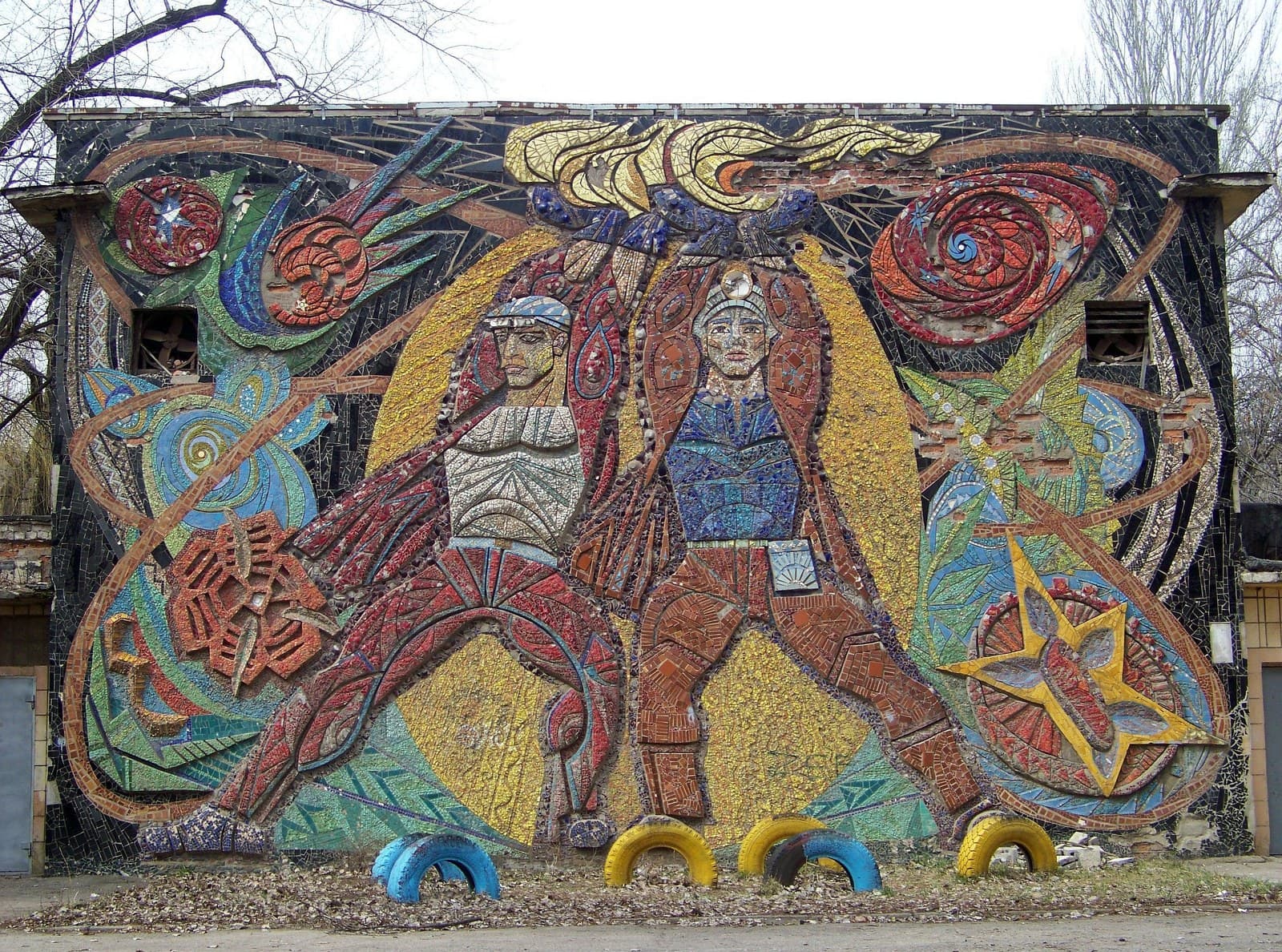
Prometheuses (mosaic cycle of School No. 5, Donetsk)
The central panel of a nine-part cycle made in 1965–1966 by a collective led by Hryhorii Synytsia with Alla Horska, Halyna Zubchenko, Viktor Zaretskyi and Hennadii Marchenko: two figures raise a flame between cosmic spirals and folk-ornament suns. Eight smaller panels — «Космос», «Вода», «Вогонь», «Земля», «Життя», «Надра», «Сонце», «Повітря/Верба» — were completed in 1965, the central «Прометеї» in 1966.
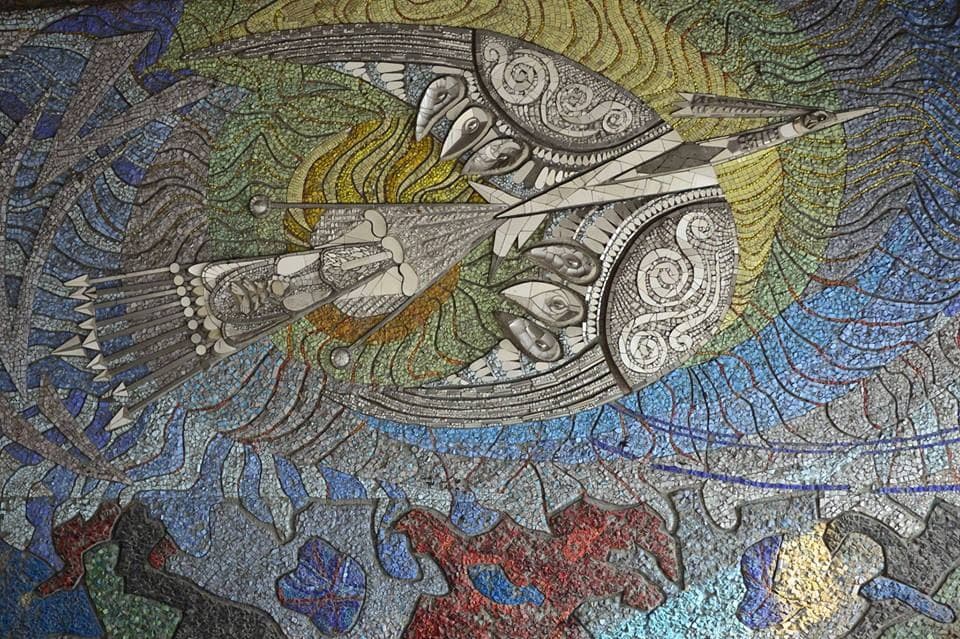
Kestrel (Boryviter)
A hovering kestrel built from smalt, its silver-grey plumage spread across a sun and a field of blue that answered the sea visible from the restaurant windows; the bird was read as an emblem of artistic freedom. Made with a team including Viktor Zaretskyi, Halyna Zubchenko, Borys Plaksii, Hryhorii Pryshedko, Vasyl Prakhnin and Nadiia Svitlychna in under two months, rediscovered behind a wall during a 2008 renovation, and destroyed with its companion panel during the Russian bombardment of Mariupol in 2022. It gave its name to Horska's 2024 retrospective at the Ukrainian House in Kyiv. Also referred to in Ukrainian sources as «Птах-мрія».
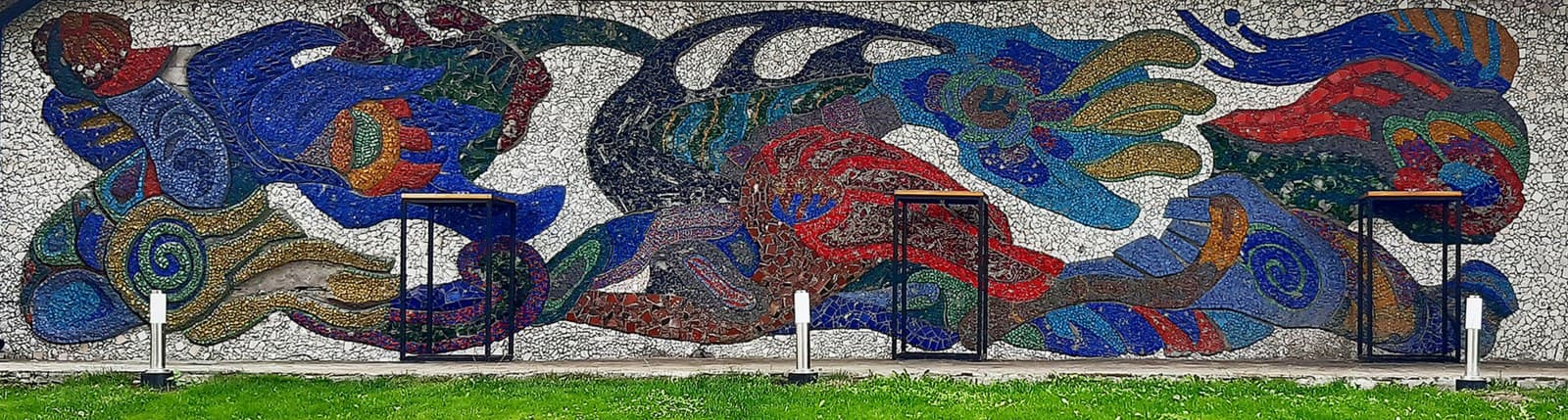
Wind
An abstract composition begun in 1967 and finished in 1968 by Horska with Viktor Zaretskyi and Borys Plaksii, fusing folk-ornament motifs with a Ukrainian avant-garde vocabulary. It is one of the few Horska mosaics still in place in Kyiv.