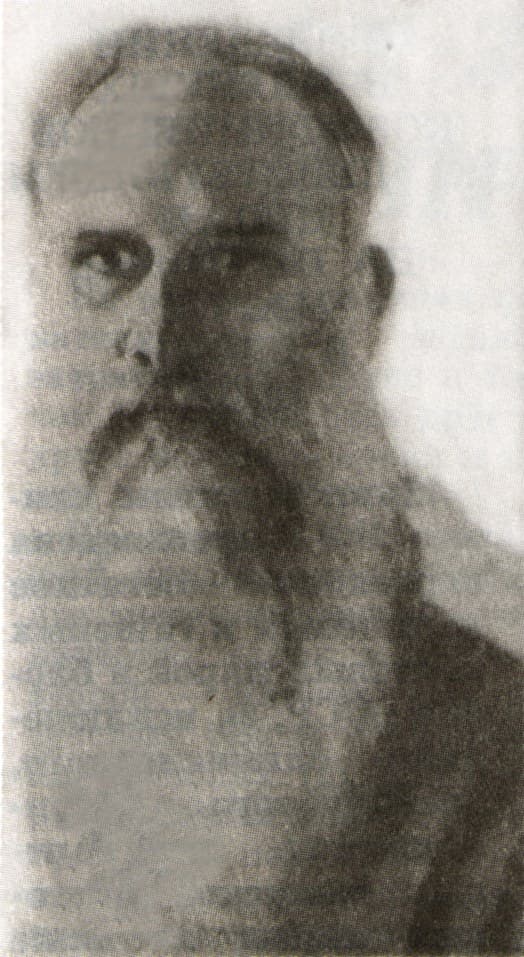
Ivan Miasoiedov was a painter, draughtsman and engraver born in Kharkiv and raised on his family's estate near Poltava, where he led a bohemian artists' circle and painted Ukrainian landscapes alongside large symbolist compositions on antique myth. He was also a champion weightlifter, a wartime artist, a convicted counterfeiter and, from 1938, the designer of Liechtenstein's postage stamps under the name Eugen Zotow. His early Poltava-period work is held by the Poltava Art Museum, and the bulk of his later output by the Zotow–Miasoiedov Foundation in Vaduz.
Ivan Miasoiedov was born in 1881 in Kharkiv, the son of the Peredvizhniki painter Grigoriy Myasoyedov and the artist Kseniia Ivanova, and grew up on the family's Pavlenky estate near Poltava. He studied at the Alexander Real School in Poltava, then at the Moscow School of Painting, Sculpture and Architecture (1896–1901), and completed his training in the battle-painting studio of the Imperial Academy of Arts in St Petersburg (1907–1909), also learning engraving from Vasyl Mate. A powerful athlete, he took prizes in All-Russian weightlifting championships and briefly wrestled in circuses, where he met his wife, the Italian dancer Malvina Vernizzi. His large canvases of the 1900s and 1910s — Argonauts, centauromachies, amazons, bacchanals — belong to the symbolist and Art Nouveau current rather than to his father's realism, while his landscapes of Poltava, the Pavlenky manor, Ukrainian villages and Crimea are painted in a loose, light-filled plein-air manner. After his father's death in 1911 he settled in Poltava and gathered a bohemian artistic circle known as the 'Garden of Gods'; he and Malvina travelled through Ukrainian villages collecting folk costumes and studying local dances. Evacuating with the White forces in 1919, he reached Berlin in 1921, where he and his wife were twice imprisoned for counterfeiting currency; from 1938 he lived in Vaduz under the assumed name Eugen Zotow, becoming Liechtenstein's first professional stamp designer and a prolific painter of landscapes, still lifes, portraits and murals. He died in Buenos Aires in 1953. About 4,000 works are catalogued, some 3,200 of them in the Vaduz foundation named after him, while his early Ukrainian works remain in Poltava, many of the museum's holdings having been lost in the 1943 fire and the German occupation.
Art Movements
Realism
Realism is an artistic movement that sought to depict reality as accurately and objectively as possible, holding that the purpose of art is to reflect all aspects of existence, rather than merely its idealized representation. The term was introduced by the French literary critic Jules Champfleury in the 1850s to denote art that opposed Romanticism and Academicism. In the visual arts, the significance of Realism as a style is quite controversial, and its boundaries are undefined. In a narrower sense, realism is understood as positivism, a movement in the visual arts of the second half of the 19th century. One of the first realists was the French artist Gustave Courbet (1819–1877), who opened his solo exhibition “The Pavilion of Realism” in Paris in 1855. Before him, artists of the Barbizon School—Théodore Rousseau, Jean-François Millet, and Jules Breton—worked in a realistic style. In the 1870s, realism split into two main movements: naturalism and impressionism. In contemporary painting, realism borders on the grotesque and anti-glamour.
Explore movement →Modernism
Modernism was a radical, early-to-mid-20th-century cultural movement that broke with traditional artistic, literary, and social forms to align with a rapidly industrializing world. Characterized by experimentation, abstraction, and individualism, it sought new modes of expression to address themes of alienation and social change following World War I. Rejection of Tradition: Modernists rejected Victorian morality, academic art, and realistic depictions of subjects, seeking to "make it new". Experimentation: A shift towards abstraction in art (e.g., Cubism) and new techniques in literature, such as stream of consciousness (e.g., Virginia Woolf, James Joyce). Key Themes: Focused on subjectivity, alienation, the fragmentation of reality, and the quest for new meaning. Architecture & Design: Marked by minimalism, functionalism, and the use of industrial materials, famously summarized by Le Corbusier’s "a building is a machine for living in". Time Period: Roughly 1890s–1960s, emerging in Europe and America as a response to urbanization and technological advances.
Explore movement →1880s–1910sSymbolism
A late nineteenth- and early twentieth-century movement that turned away from the documentary aims of realism toward myth, allegory, dream and inner experience. In Ukraine it arrived through Kyiv, Poltava, Kharkiv and Lviv art circles and through artists trained in Munich, Paris and St Petersburg, and it fed directly into Ukrainian Art Nouveau and early modernism. Ukrainian symbolists favoured antique and folk mythology, ritual and allegorical figure compositions over contemporary social subjects.
Explore movement →Works by Ivan Miasoiedov
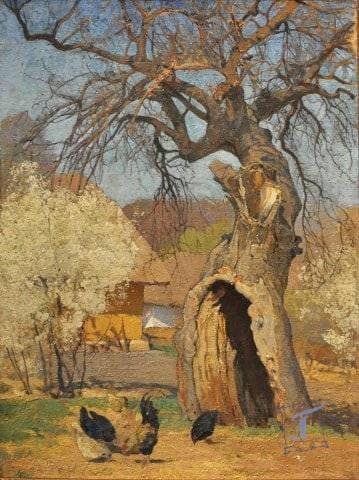
The Hollow Tree
An early plein-air study from the artist's Poltava years, built around a single split, hollowed trunk in open countryside. It belongs to the group of works that passed into the Poltava Art Museum directly from Miasoiedov's own estate, and shows him working from nature well before the mythological canvases of the following decade.
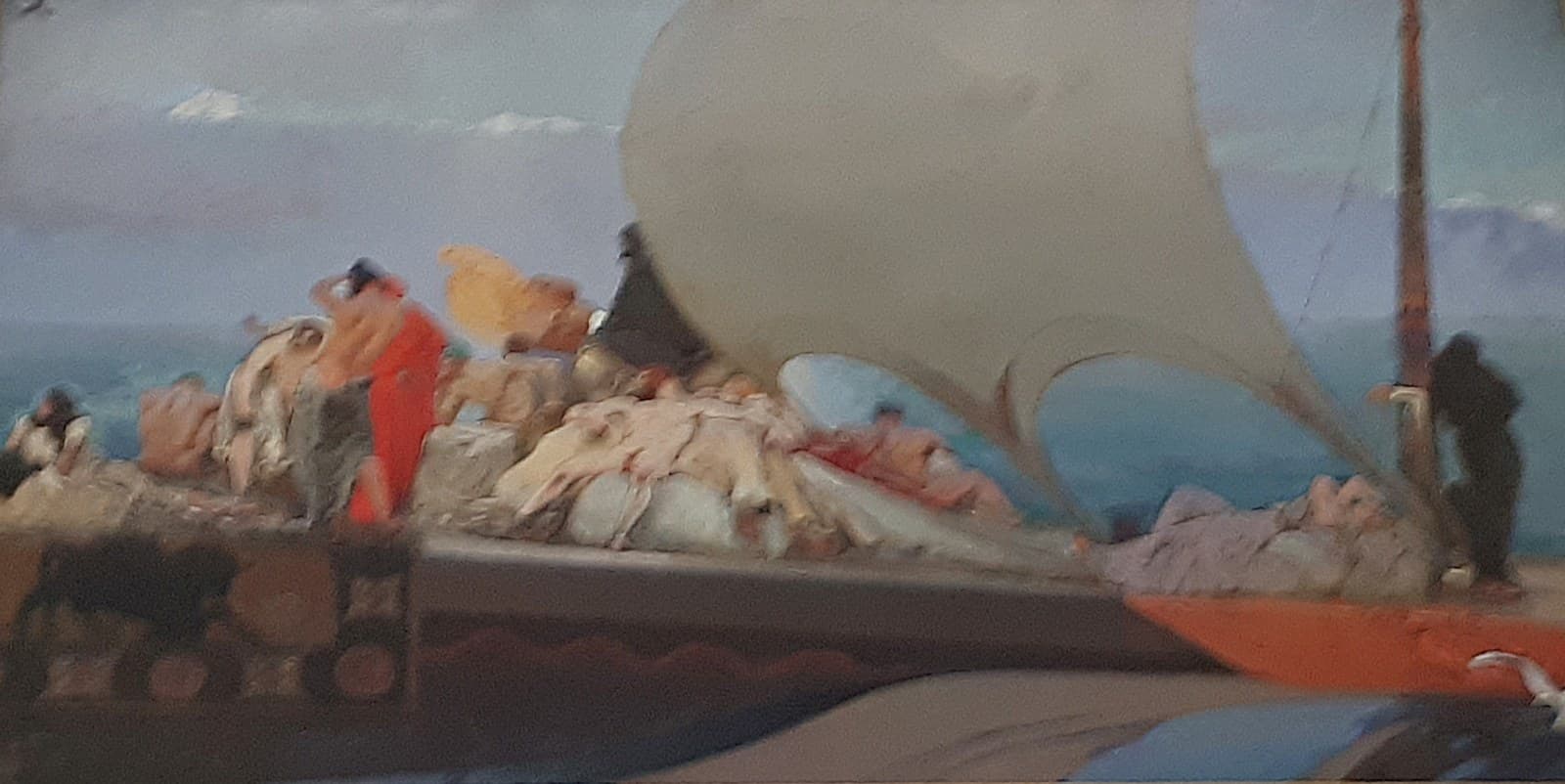
The Voyage of the Minyans
A monumental frieze-like composition of the Minyan heroes — the Argonauts — setting out for Colchis, rowing a long ship past a crowded shore. Painted for the Academy of Arts, it is the clearest example of Miasoiedov's turn from his father's social realism to antique myth handled in the manner of Central European symbolism.
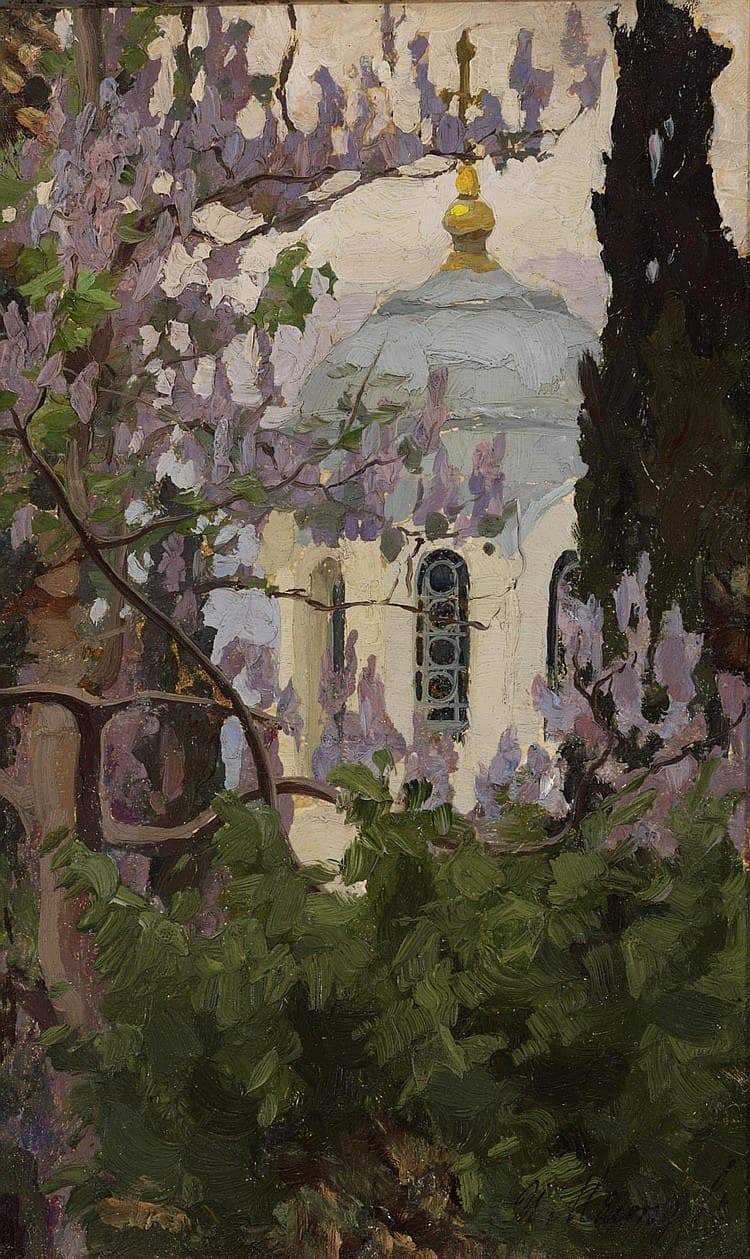
Church Dome (Church in Hurzuf)
A steeply upward-looking view of a church dome painted during one of Miasoiedov's Crimean campaigns in Hurzuf, handled in broad, light-saturated brushwork. It belongs to the Crimean series that also includes Alupka and Tatar Cemetery in the Crimea.
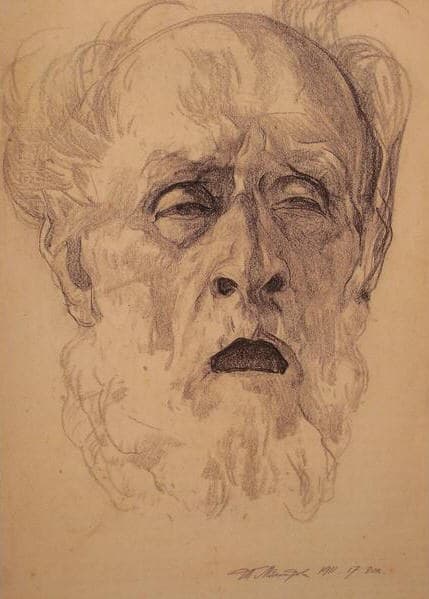
Portrait of the Dying Father. Agony
Miasoiedov painted his father Grigoriy Myasoyedov from life as he lay dying at Pavlenky in 1911, an unflinching deathbed portrait with none of the consolation of nineteenth-century funerary painting. The picture marks the end of his father's Poltava household and the beginning of Miasoiedov's own decade there.