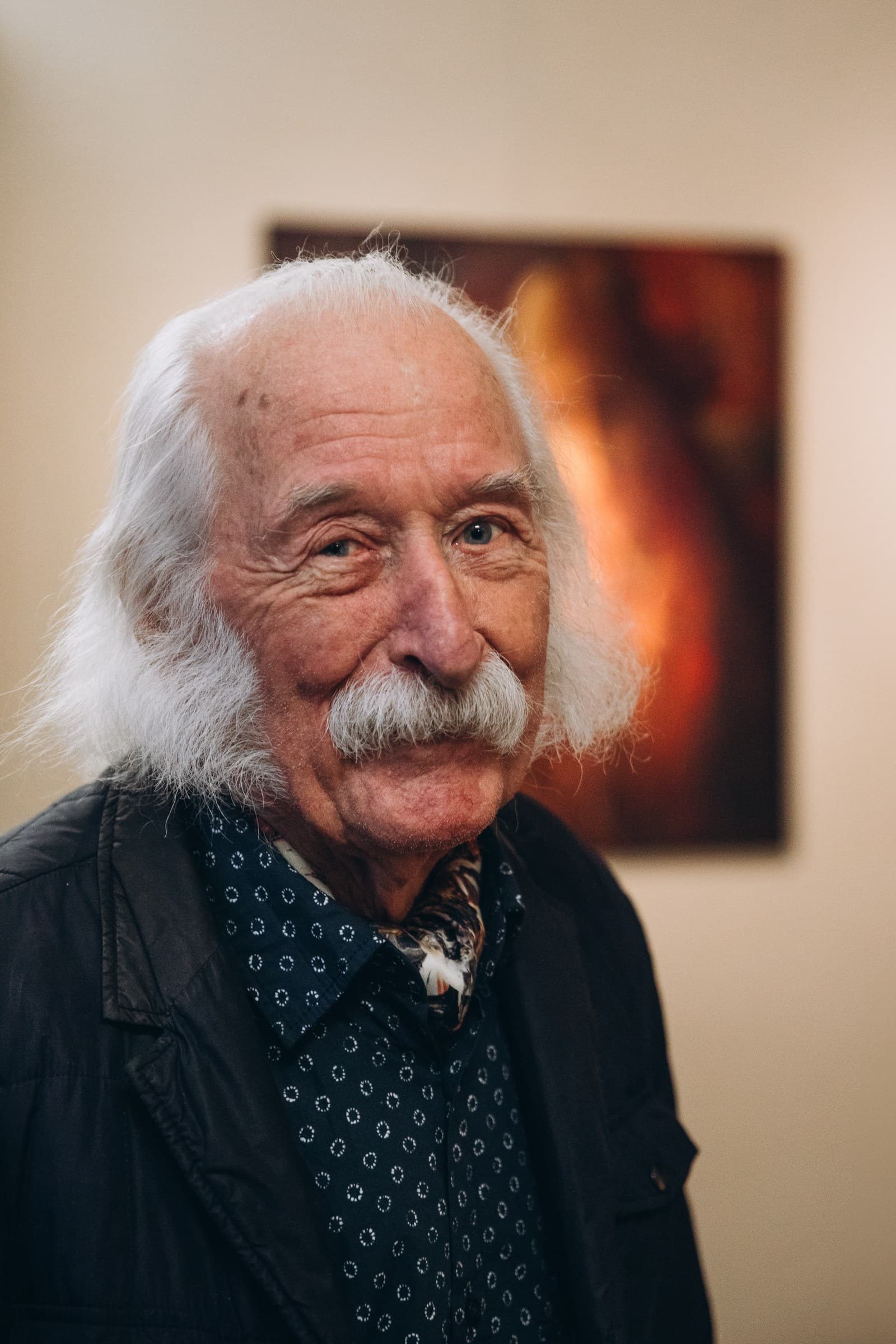
Ivan Marchuk
Іван Марчук
b. 1936 · Moskalivka, Kremenets raion, Ternopil Oblast, Ukraine
Ivan Marchuk (b. 1936) is a Ukrainian painter who invented "pliontanizm", a technique of building an image out of thousands of fine interwoven threads of paint instead of brushstrokes. He works in long cycles — among them "Voice of My Soul", "Shevchenkiana", "White Planet" and "Vienna Rhapsodies" — that move between landscape, portrait and visionary allegory.
Ivan Stepanovych Marchuk was born on 12 May 1936 in the village of Moskalivka in the Kremenets district of Ternopil Oblast, into a family of weavers. He studied at the Ivan Trush College of Decorative and Applied Arts in Lviv (1951–1956) and at the Lviv Institute of Applied and Decorative Arts (1960–1965), then worked at the Institute for Superhard Materials in Kyiv and at the Kyiv Monumental-Decorative Art Complex before turning to full-time painting in 1984. Around the late 1960s he developed the technique he named "pliontanizm" (from the dialect word for plaiting), laying down dense skeins of thread-like coloured lines that give his canvases a woven, luminous surface. Officially marginalised in the Soviet period, he lived and exhibited in Australia, Canada and the United States between 1989 and 2001 before returning to Ukraine. He was awarded the Taras Shevchenko National Prize in 1997 for the "Shevchenkiana" cycle, named People's Artist of Ukraine in 2002, and included in the Telegraph's 2007 list of 100 living geniuses. His work is organised into some fifteen cycles and totals several thousand pieces, held in the Taras Shevchenko National Museum and in private collections across Europe, the Americas and Australia. Since the full-scale Russian invasion in 2022 he has been based in Vienna, where he began the "Vienna Rhapsodies" cycle. In 2024 the National Bank of Ukraine issued a commemorative coin series titled "Pliontanizm (Ivan Marchuk)" with designs drawn from his own paintings.
Art Movements
Surrealism
Surrealism is a 20th-century avant-garde movement that sought to release the creative potential of the unconscious mind, blending dream-like imagery with rational absurdity. Founded by André Breton in Paris in 1924, it influenced literature, art, and film by using automatism and unexpected juxtapositions to challenge traditional reality. Key Aspects of Surrealism: Origin: Emerging from the Dada movement in the 1910s, it was officially established by André Breton’s Manifesto of Surrealism (1924). Core Influences: Deeply influenced by Sigmund Freud’s theories on the unconscious mind and dreams, as well as Karl Marx’s political ideology. Techniques: Artists used techniques like automatic drawing/writing, collage, and "exquisite corpse" games to bypass conscious thought and societal constraints. Visual Styles: The movement included two main tendencies: highly detailed, realistic dreamscapes (e.g., Salvador Dalí) and abstract, organic, or suggestive imagery (e.g., Joan Miró). Major Figures: Key artists include Salvador Dalí, René Magritte, Max Ernst, Joan Miró, Meret Oppenheim, and Dorothea Tanning. Impact: Beyond visual arts, Surrealism was a global, interdisciplinary movement that impacted cinema, literature, and political thought.The movement aimed to resolve the contradictory conditions of dream and reality into an absolute reality, or "surreality".
Explore movement →Magical realism
Magical realism is a genre of literature, art, and film that incorporates fantastic, mythical, or surreal elements into otherwise realistic, mundane narratives, treating the magical as normal. It blurs the boundary between reality and fantasy, often used to explore complex social, political, or postcolonial themes through a dreamlike lens. Key Aspects and Characteristics Realistic Setting: Stories are rooted in the real world (e.g., bustling cities, quiet villages), not fantasy realms. Normalised Magic: Strange occurrences are accepted by characters without surprise or terror. Hybridity: Often blends folklore, myths, or spiritual beliefs with modern reality. Sociopolitical Critique: Often used to address issues like colonization, dictatorship, and trauma.
Explore movement →1880s–1910sSymbolism
A late nineteenth- and early twentieth-century movement that turned away from the documentary aims of realism toward myth, allegory, dream and inner experience. In Ukraine it arrived through Kyiv, Poltava, Kharkiv and Lviv art circles and through artists trained in Munich, Paris and St Petersburg, and it fed directly into Ukrainian Art Nouveau and early modernism. Ukrainian symbolists favoured antique and folk mythology, ritual and allegorical figure compositions over contemporary social subjects.
Explore movement →1991–presentContemporary Ukrainian Painting
Painting made in independent Ukraine, from the 1991 declaration of independence onward. It is pluralist rather than programmatic: plein-air landscape and psychological portraiture continue alongside conceptual, minimalist and symbolist strands, with a marked turn after 2014 and especially after 2022 toward wartime subjects, national memory and the vernacular Ukrainian village.
Explore movement →Works by Ivan Marchuk
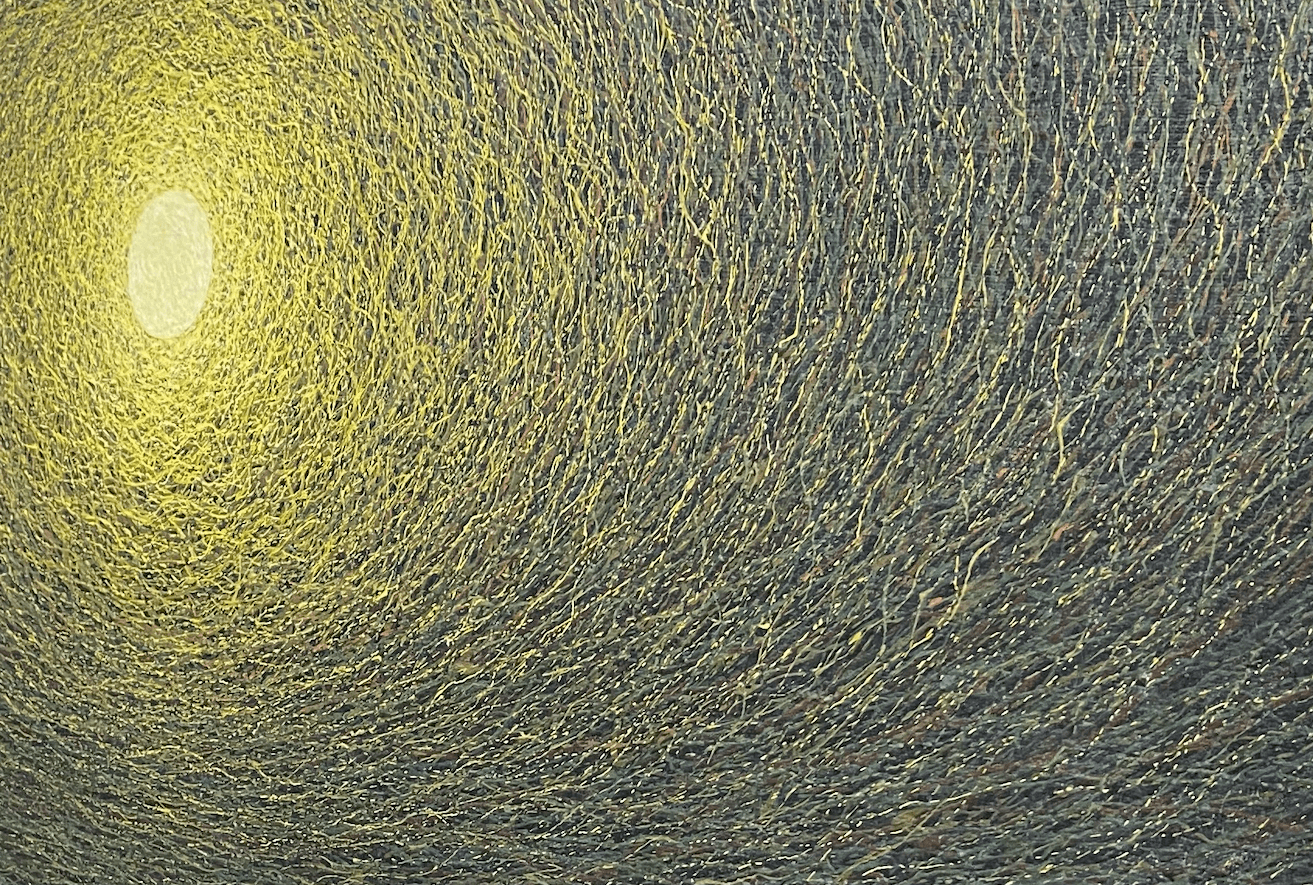
The Moon Rose over the Dnipro
A moonlit nocturne over the Dnipro, Marchuk's largest treatment of a moonlit night, in which the whole surface is spun from fine looping filaments of paint. In June 2024 it set an auction record for a contemporary Ukrainian artist at the Goldens house in Kyiv.
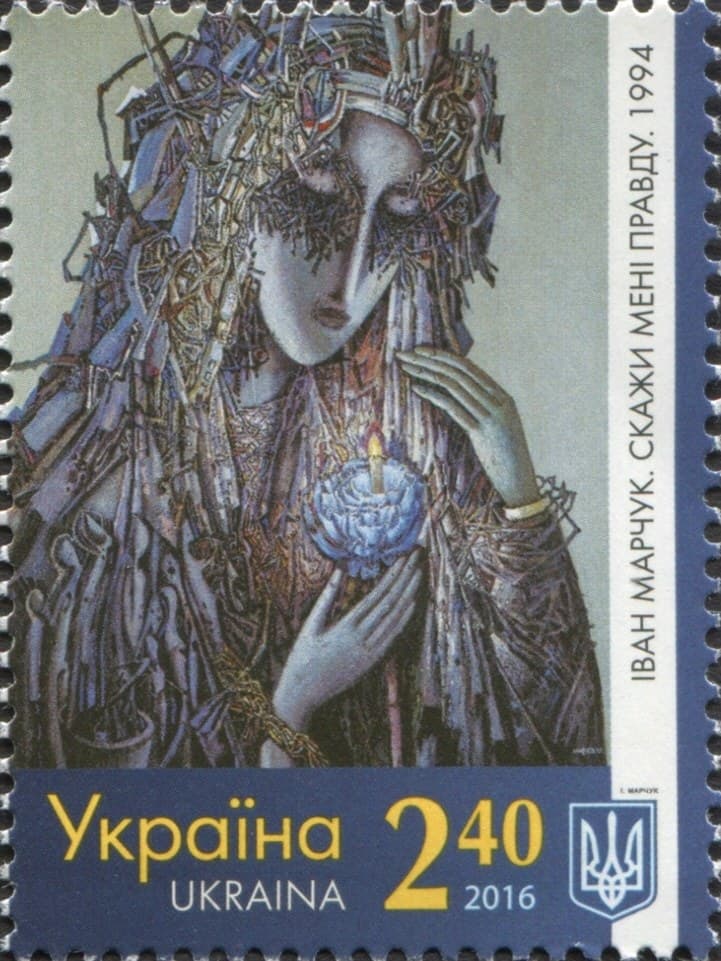
Tell Me the Truth
A frontal, icon-like female figure sheathed in a bristling armour of thread-fine strands, cupping a lit candle set inside a pale flower. Ukrposhta reproduced the painting in full on a 2.40 UAH definitive stamp in 2016.
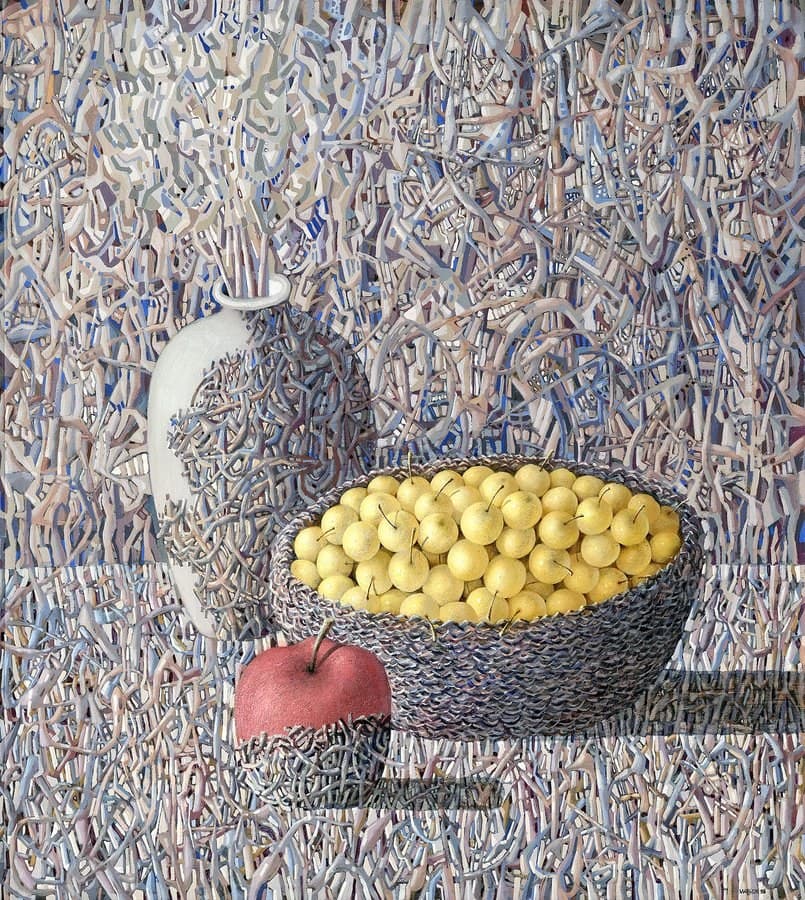
Garden of Temptation
A still life from Marchuk's mature pliontanizm period, built from dense threads of colour. In June 2022 it sold for USD 120,000 at a charity auction in Kyiv with the proceeds going to the Ukrainian Armed Forces, placing it fifth in Lokalna Istoriia's ranking of the most expensive paintings by Ukrainian artists.