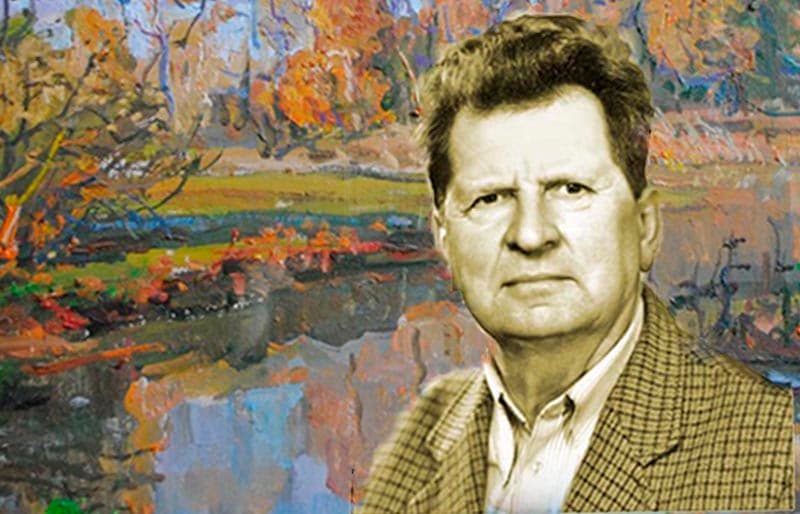
Volodymyr Zhuhan
Володимир Жуган
1926–2008 · Lykhivka, Piatykhatky district, Dnipropetrovsk Oblast, Ukraine
Volodymyr Zhuhan (1926–2008) was a Ukrainian painter from the Dnipro region and one of the originators of the Ukrainian industrial landscape. A Second World War veteran, he built a career around the scenery, rivers and heavy industry of Dnipropetrovsk and Poltava oblasts. He was made a Merited Artist of Ukraine in 2006.
Volodymyr Oleksandrovych Zhuhan was born on 27 August 1926 in the village of Lykhivka in the Piatykhatky district of what is now Dnipropetrovsk Oblast. He was called up in July 1944 and saw combat in the Second World War before enrolling at the Dnipropetrovsk Art School, graduating in 1950 under Mykhailo Panin and Mykola Pohribniak with a diploma painting titled "Steel Workers." From 1951 to 1956 he ran the fine-art studio at the Dniprodzerzhynsk Palace of Pioneers, after which he worked full-time as an artist. He joined the Union of Artists of Ukraine in 1964, showed in oblast exhibitions from 1951, all-Ukrainian ones from 1961 and all-Union ones from 1954, and held solo exhibitions in Kyiv (1980) and Dnipropetrovsk (1980, 1986). He worked in both easel and monumental painting, and is often credited as one of the founders of the industrial landscape genre in Ukrainian art; his "Industrial Landscape" pictures and canvases of the Dnipro dams and the Dnipro–Donbas canal sit alongside quieter compositions of village orchards, meadows and the river itself. Critics of the period praised the way his Dnipropetrovsk and Poltava landscapes were compositionally tightened into a poetic image of the home country. Later in life he turned to the extended cycle «Моя квітуча земля» ("My Blooming Land", 1992–2001). He was named a Merited Artist of Ukraine in 2006 and died on 15 September 2008 in Dniprodzerzhynsk; his work is held by the Dnipro and Donetsk art museums, the Dnipro and Dniprodzerzhynsk history museums and the Kamianets-Podilskyi local-history museum.
Art Movements
Realism
Realism is an artistic movement that sought to depict reality as accurately and objectively as possible, holding that the purpose of art is to reflect all aspects of existence, rather than merely its idealized representation. The term was introduced by the French literary critic Jules Champfleury in the 1850s to denote art that opposed Romanticism and Academicism. In the visual arts, the significance of Realism as a style is quite controversial, and its boundaries are undefined. In a narrower sense, realism is understood as positivism, a movement in the visual arts of the second half of the 19th century. One of the first realists was the French artist Gustave Courbet (1819–1877), who opened his solo exhibition “The Pavilion of Realism” in Paris in 1855. Before him, artists of the Barbizon School—Théodore Rousseau, Jean-François Millet, and Jules Breton—worked in a realistic style. In the 1870s, realism split into two main movements: naturalism and impressionism. In contemporary painting, realism borders on the grotesque and anti-glamour.
Explore movement →Social Realism
Social Realism is an international art movement—spanning painting, photography, literature, and film—that emerged in the mid-19th century and peaked in the 20th century to expose the harsh socio-political conditions of the working class. It functions as a critical, unidealized depiction of poverty, labor struggles, and structural inequality to challenge power structures. Key Characteristics and Context Purpose: To draw attention to the everyday hardships of the poor and working classes, often functioning as a critique of capitalist, industrial, or governmental systems. Origin: The movement grew from 19th-century French and Russian realism, reacting against romanticism and bourgeois art styles. Resurgence: It thrived between the World Wars and during the 1930s Great Depression, particularly in the U.S. and Mexico, focusing on themes of labor, community, and resilience. Style: It emphasizes subject matter over form, often using a descriptive, gritty, and direct visual language.
Explore movement →Works by Volodymyr Zhuhan
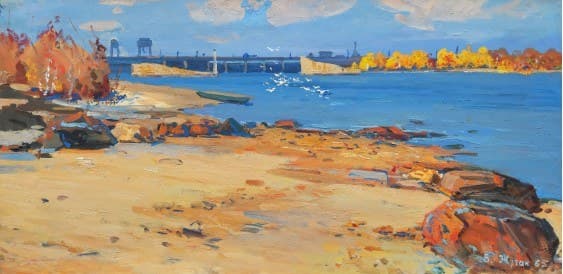
The Dzerzhynsk Dam
A wide horizontal canvas of the dam serving the Dzerzhynskyi metallurgical works, characteristic of Zhuhan's industrial landscapes of the 1960s.
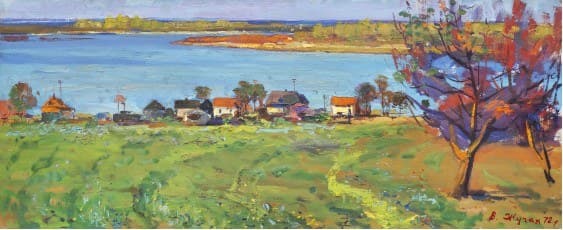
Village Above the Dnipro
A panoramic view of a settlement on the high bank of the Dnipro, one of the lyrical counterparts to Zhuhan's industrial subjects.
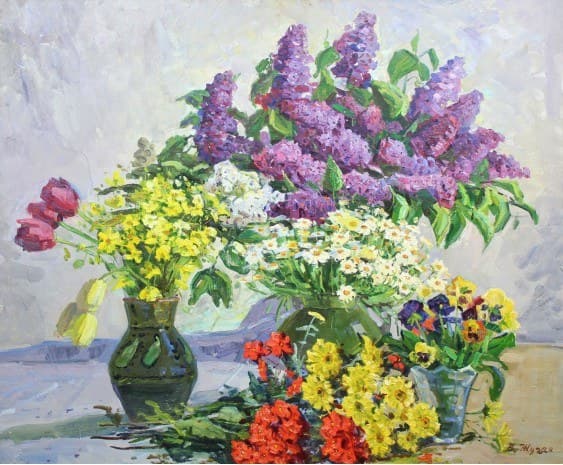
Spring Flowers
A large-format floral still life from the mid-1970s, showing the side of Zhuhan's practice furthest from his industrial commissions.
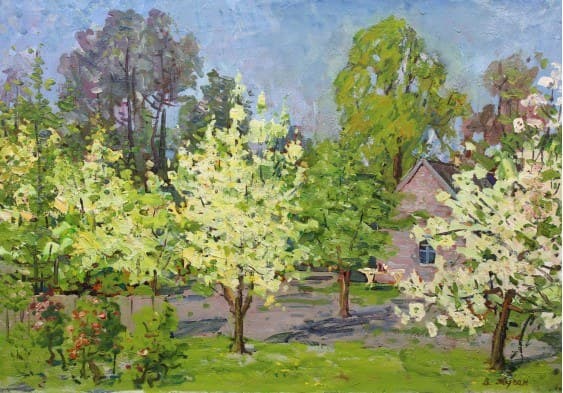
The Orchard
An undated orchard landscape; the gallery explicitly records the work as "Не датовано" (not dated), so no year is asserted here.