Vasyl Nepyipyvo
Василь Непийпиво
1916–2007 · Kamianka, Poltava uyezd, Poltava governorate (now Stasi, Poltava raion, Poltava oblast), Ukraine
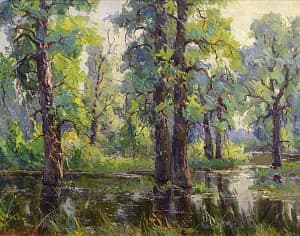
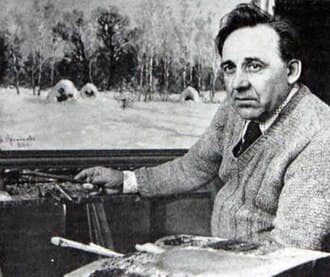
Vasyl Nepyipyvo was a Ukrainian landscape and still-life painter, People's Artist of the Ukrainian SSR (1982), who worked entirely outside formal art education. A self-taught graduate of a Kharkiv art studio and a Second World War veteran, he built a career on lyrical panoramas of the Dnipro, Poltava region and Kyiv. Critics described his landscapes as epic, romantic and unusually rich in colour, rooted in the tradition of Ukrainian realist landscape painting.
Vasyl Hnatovych Nepyipyvo was born on 28 December 1915 (10 January 1916 New Style) in the village of Kamianka in the Poltava uyezd of Poltava governorate — today the village of Stasi in Poltava raion. He had no specialised art education beyond the Kharkiv art studio, and in 1937–1938 worked as a scenery painter at the Poltava Music and Drama Theatre before serving in the Second World War, for which he received the medal 'For the Victory over Germany' in 1945, the Order of the Red Star in 1947 and the Order of the Patriotic War, first class, in 1985. He later worked with the Kyiv regional society of artists and began exhibiting in 1950–1951, joining the Union of Soviet Artists of Ukraine in 1960; he took part in all-Union exhibitions from 1959 and held solo shows in Kyiv in 1954, 1971, 1982 and 1986, in Poltava in 1980, and a further retrospective organised by the Ministry of Culture in 2002. Working in easel painting in a realist idiom, he produced landscapes and still lifes whose expressive character conveyed the scenic corners and the architectural and artistic monuments of the Ukrainian lands; commentators noted the epic sweep, romanticism and colouristic richness of his work, while acknowledging that his immediate post-war canvases bore the narrative stamp of official Soviet aesthetics. A distinct strand of his output is devoted to Kyiv, which he painted through every season in a register at once ceremonial and warm, deliberately avoiding anything purely urban. He was named an Honoured Artist of the UkrSSR in 1977 and People's Artist of the UkrSSR in 1982, and lived in Kyiv on Sichnevoho Povstannia Street until his death on 19 January 2007. His work is held by the National Art Museum of Ukraine and by regional and art museums in Volyn, Zhytomyr, Zaporizhzhia, Ivano-Frankivsk, Uman, Dnipro, Poltava and Kharkiv.
Art Movements
Realism
Realism is an artistic movement that sought to depict reality as accurately and objectively as possible, holding that the purpose of art is to reflect all aspects of existence, rather than merely its idealized representation. The term was introduced by the French literary critic Jules Champfleury in the 1850s to denote art that opposed Romanticism and Academicism. In the visual arts, the significance of Realism as a style is quite controversial, and its boundaries are undefined. In a narrower sense, realism is understood as positivism, a movement in the visual arts of the second half of the 19th century. One of the first realists was the French artist Gustave Courbet (1819–1877), who opened his solo exhibition “The Pavilion of Realism” in Paris in 1855. Before him, artists of the Barbizon School—Théodore Rousseau, Jean-François Millet, and Jules Breton—worked in a realistic style. In the 1870s, realism split into two main movements: naturalism and impressionism. In contemporary painting, realism borders on the grotesque and anti-glamour.
Explore movement →Romanticism
Romanticism—an ideological and artistic movement in European and American culture from the late 18th century to the first half of the 19th century—is characterized by the affirmation of the intrinsic value of the individual’s spiritual and creative life, the depiction of intense (often rebellious) passions and characters, and the portrayal of nature as inspiring and healing. It spread to various spheres of human activity. In the 18th century, anything strange, picturesque, and existing in books rather than in reality was called romantic. At the beginning of the 19th century, Romanticism became the name for a new movement, opposed to Classicism and the Enlightenment.
Explore movement →