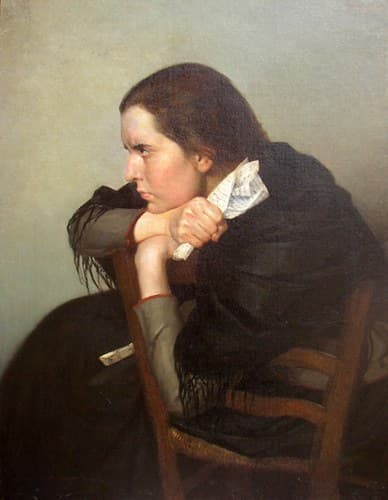
Serafyma Blonska
Серафима Блонська
1870–1947 · Verkhnodniprovsk, Katerynoslav Governorate, Russian Empire (now Dnipropetrovsk Oblast, Ukraine)
Serafyma Blonska was a Ukrainian painter born in Verkhnodniprovsk on the Dnipro, trained at Mykola Murashko's Kyiv Drawing School and at the Imperial Academy of Arts, with further study in Italy. Her 1900 diploma canvas Girls. Palm Sunday, a candle-lit church interior full of girls holding willow branches, is one of the finest Ukrainian paintings of Easter-cycle ritual. With her husband, the Myrhorod-born painter Oleksandr Leontovskyi, she ran a drawing school in Taganrog for eighteen years, teaching orphaned children free of charge.
Serafyma Blonska was born in 1870 in Verkhnodniprovsk, Katerynoslav Governorate, and from the age of five lived with her family in Taganrog, where she finished the gymnasium with a gold medal. She went on to Mykola Murashko's Kyiv Drawing School, the institution that also trained Mykola Pymonenko, Ivan Yizhakevych, Mykhailo Zhuk, Kazimir Malevich and Valentin Serov, and then completed her education at the Imperial Academy of Arts in St Petersburg, followed by a study period in Italy. Her 1900 Academy diploma work, Girls. Palm Sunday, shows adolescent girls at a festal night service with lit candles and willow branches, their faces deliberately echoing the saints painted on the church walls; the picture's pale, clear tonality gives it an unmistakably celebratory mood. On returning to St Petersburg she fell gravely ill with typhoid fever and was nursed by a former Academy classmate, the Myrhorod-born painter Oleksandr Leontovskyi, whom she married in 1910. The couple moved permanently to Taganrog and opened a school of drawing and painting, charging students a nominal twenty-five kopecks a month and teaching orphans without payment; the school ran until Leontovskyi's death in 1928. Blonska continued to paint landscapes, flower pieces and rural scenes such as Geese and Poppies, both now in the Taganrog Art Museum. She died in 1947 and lay in an unmarked grave in the old Taganrog cemetery until a headstone was finally erected at municipal expense in 2010, sixty-three years later.
Art Movements
Realism
Realism is an artistic movement that sought to depict reality as accurately and objectively as possible, holding that the purpose of art is to reflect all aspects of existence, rather than merely its idealized representation. The term was introduced by the French literary critic Jules Champfleury in the 1850s to denote art that opposed Romanticism and Academicism. In the visual arts, the significance of Realism as a style is quite controversial, and its boundaries are undefined. In a narrower sense, realism is understood as positivism, a movement in the visual arts of the second half of the 19th century. One of the first realists was the French artist Gustave Courbet (1819–1877), who opened his solo exhibition “The Pavilion of Realism” in Paris in 1855. Before him, artists of the Barbizon School—Théodore Rousseau, Jean-François Millet, and Jules Breton—worked in a realistic style. In the 1870s, realism split into two main movements: naturalism and impressionism. In contemporary painting, realism borders on the grotesque and anti-glamour.
Explore movement →Impressionism
Impressionism was a 19th-century French art movement (1870s-1880s) that revolutionized Western art by capturing fleeting moments and the shifting effects of light using visible brushstrokes, open composition, and vibrant colors. Focusing on modern life and landscapes, key artists included Claude Monet, Pierre-Auguste Renoir, Camille Pissarro, and Berthe Morisot. Usage Examples & Characteristics: Plein Air Painting: Painting outdoors to capture natural light, such as Monet’s studies of Rouen Cathedral or haystacks in varying weather conditions. Visible Brushwork: Thick, rapid, or broken brushstrokes intended to convey a sense of motion and the ephemeral nature of a scene. Everyday Subjects: Depicting leisure activities, urban life in Paris, or landscapes rather than historical or mythological scenes. Unusual Visual Angles: Inspired by photography, artists like Degas used candid-style, unconventional framing of subjects, such as dancers or laundresses. "Impressionist Music": A similar approach in music and dance, focusing on mood and atmosphere over rigid structure, with artists like Claude Debussy and Maurice Ravel.
Explore movement →Works by Serafyma Blonska
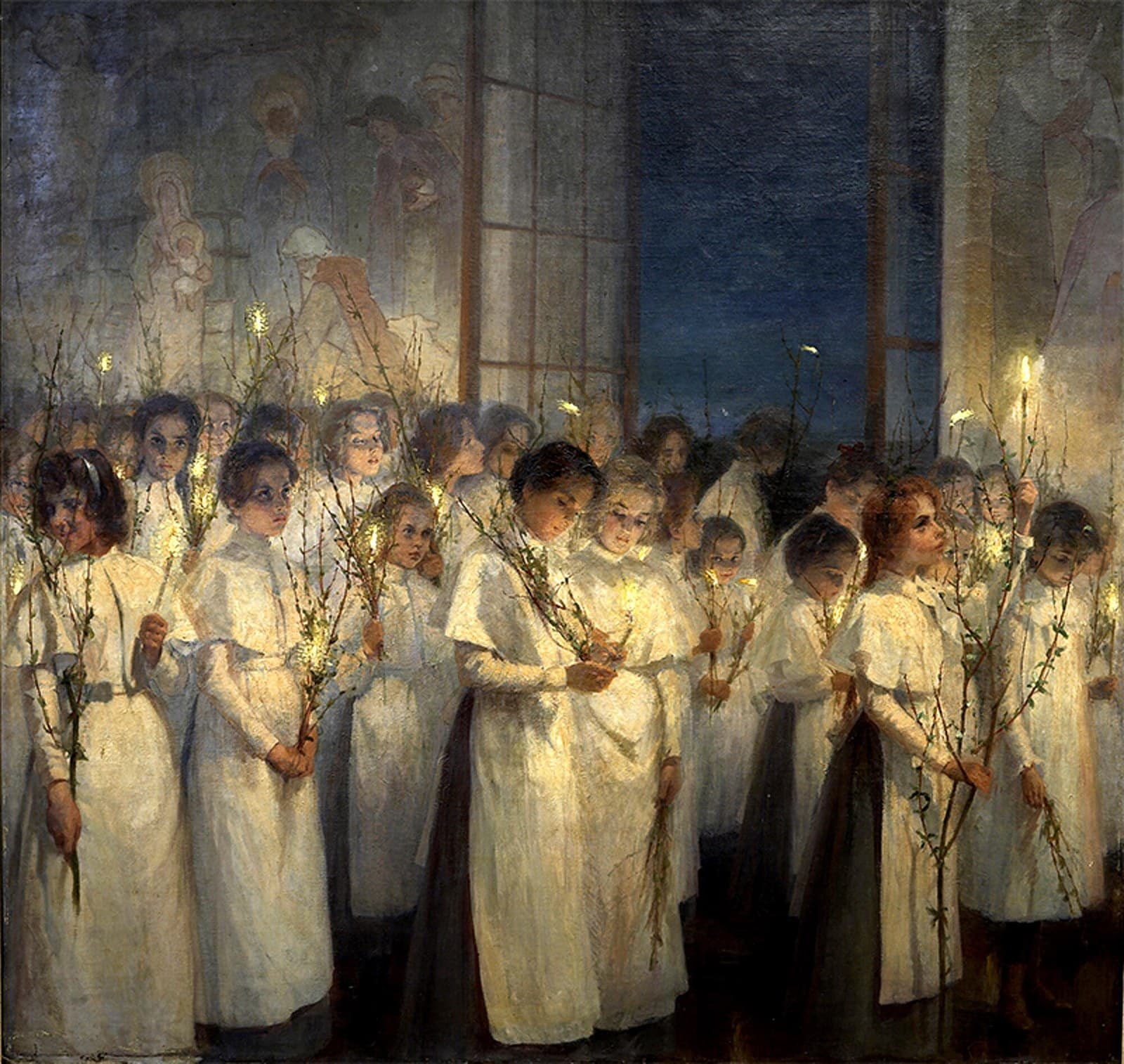
Girls. Palm Sunday
Blonska's Academy diploma painting shows a group of girls at a Palm Sunday night service, holding pussy-willow branches and burning candles, with the blue night sky visible through the open church doors. She built the composition so that the girls' faces answer the faces of the saints in the wall paintings behind them, and kept the whole canvas in pale, clear tones; she gave the picture to the city of Taganrog in 1942.
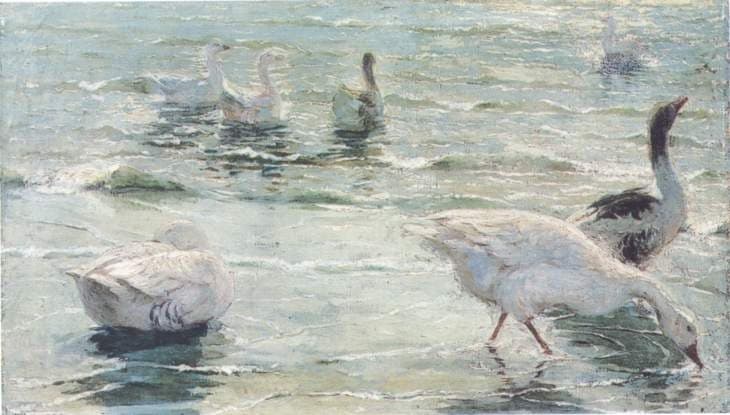
Geese
A small plein-air study of a flock of geese in bright daylight, painted three years after her diploma work in a much freer, more broken touch. It belongs to the group of Blonska's canvases preserved in the Taganrog Art Museum.
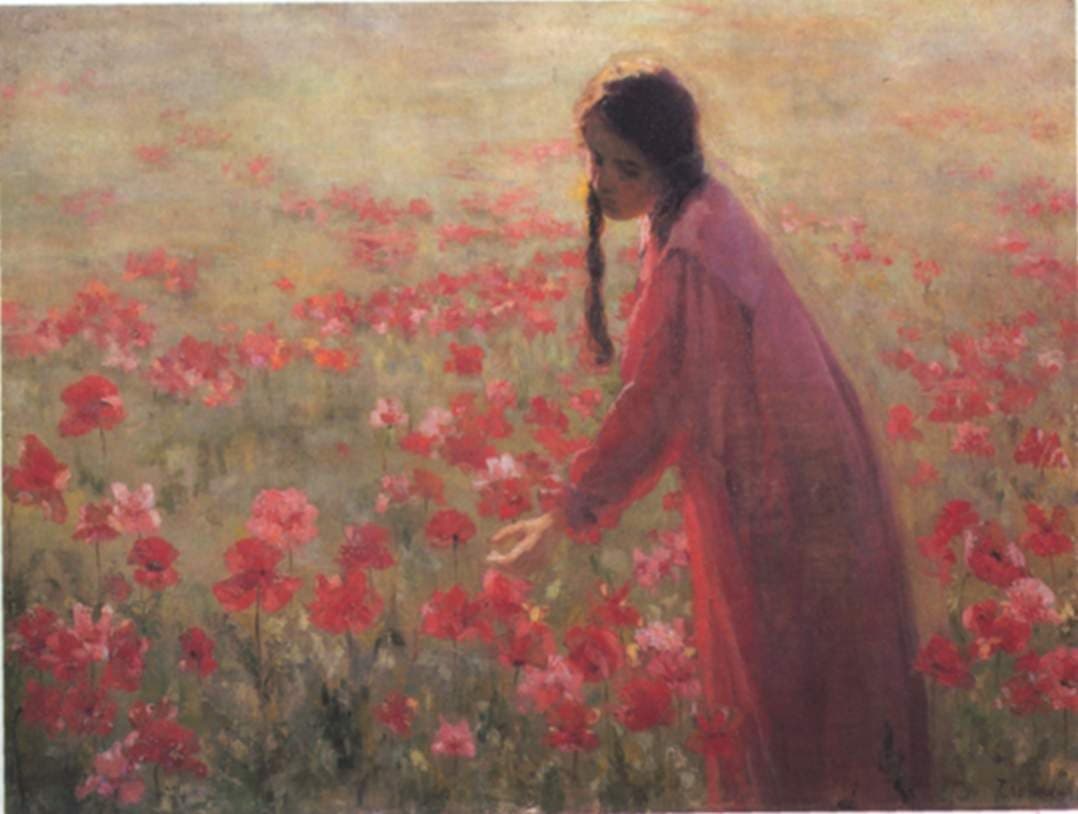
Poppies
A field of poppies painted directly from nature, with the flowers set down in loaded red touches against loose green. Together with Geese it shows the lighter, sketch-like side of Blonska's practice after her academic training.