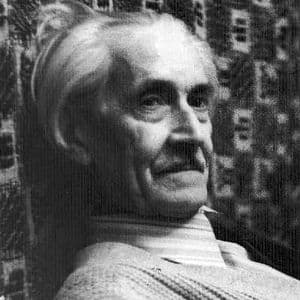
Roman Selskyi
Роман Сельський
1903–1990 · Sokal, Galicia, Austria-Hungary (now Lviv Oblast, Ukraine)
Roman Selskyi was the central figure of twentieth-century Lviv painting and the founder of the school known as Ukrainian colourism, in which colour rather than subject carries the picture. Trained in Kraków and Paris, where he worked at Fernand Léger's Académie Moderne, he brought European modernism back to Galicia and first chaired the avant-garde group 'Artes'. As a professor in Lviv from 1947 he taught for nearly thirty years and shaped a generation of painters who kept a non-doctrinal practice alive in Soviet Ukraine.
Roman Selskyi was born in 1903 in Sokal in Galicia, the son of the lawyer and translator Yulian Selskyi; the family settled in Lviv in 1905. His father wanted him in law, but a gymnasium teacher, Leon Dovzhytskyi, spotted his talent, and friends took him to Oleksa Novakivskyi, whose pupil he became. He studied at the Lviv Art and Industrial School from 1921, entered the Kraków Academy of Fine Arts in 1922 under Julian Fałat's circle of professors — Józef Mehoffer, Józef Pankiewicz and Kazimierz Sichulski — and travelled to Paris in 1925, where he worked at Fernand Léger's Académie Moderne, befriended Mykola Hlushchenko and met his future wife, the Lviv painter Margit Reich, whom he married and with whom he honeymooned in Corsica. In 1929 he became the founding chairman of 'Artes', a Lviv group whose twelve exhibitions in Lviv, Ternopil, Warsaw and Kraków worked through surrealism, magic realism, symbolism, abstraction, cubism and constructivism, and from 1932 he showed with the Association of Independent Ukrainian Artists. From 1947 he taught at the Lviv State Institute of Applied and Decorative Arts, becoming professor in 1966 and teaching until 1974; among his students were Danylo Dovboshynskyi, Volodymyr Patyk, Liubomyr Medvid and Yevhen Lysyk, and many painters who were never formally his pupils still call themselves his students. His own work is hard to file under one label — post-impressionist, surrealist and abstract currents all run through it, and his late paintings become almost purely chromatic — but he is remembered above all as the founder of the Lviv school of colourism. His subjects were the plein-air motifs he returned to for decades: the Carpathians and Chornohora, Dzembronia, the Crimea, the Baltic port of Hel, the outskirts of Lviv, and a long series of still lifes and windows. His first solo exhibition came only in 1976, at the Lviv Picture Gallery; he was made People's Artist of the Ukrainian SSR in 1989 and died in Lviv the following year. His work is held in Lviv, Kyiv and Warsaw museums, with the Lviv National Art Gallery holding the largest group, much of it acquired from him or donated by his second wife Agnes Bachynska-Selska.
Art Movements
Post-Impressionism
Post-Impressionism (c. 1886–1905) was a French art movement that reacted against the limitations of Impressionism, favoring emotional expression, symbolic content, and structural order over realistic light depiction. Key artists included Cézanne, Van Gogh, Gauguin, and Seurat, who used vivid, unnatural colors and thick paint application to create unique styles that paved the way for modern art. Key Characteristics Symbolic and Emotional Content: Pushing beyond the objective recording of nature to express subjective emotions and symbolic meaning. Structural Order: A move away from fleeting moments toward, as Paul Cézanne aimed, making of Impressionism "something solid and durable, like the art of the museums". Vivid, Non-Naturalistic Color: Using color for emotional or decorative impact rather than just representing natural light. Distinctive Techniques: Examples include Seurat's Pointillism (tiny, systematic dots of color) and Van Gogh's expressive, swirling brushwork.
Explore movement →Modernism
Modernism was a radical, early-to-mid-20th-century cultural movement that broke with traditional artistic, literary, and social forms to align with a rapidly industrializing world. Characterized by experimentation, abstraction, and individualism, it sought new modes of expression to address themes of alienation and social change following World War I. Rejection of Tradition: Modernists rejected Victorian morality, academic art, and realistic depictions of subjects, seeking to "make it new". Experimentation: A shift towards abstraction in art (e.g., Cubism) and new techniques in literature, such as stream of consciousness (e.g., Virginia Woolf, James Joyce). Key Themes: Focused on subjectivity, alienation, the fragmentation of reality, and the quest for new meaning. Architecture & Design: Marked by minimalism, functionalism, and the use of industrial materials, famously summarized by Le Corbusier’s "a building is a machine for living in". Time Period: Roughly 1890s–1960s, emerging in Europe and America as a response to urbanization and technological advances.
Explore movement →Surrealism
Surrealism is a 20th-century avant-garde movement that sought to release the creative potential of the unconscious mind, blending dream-like imagery with rational absurdity. Founded by André Breton in Paris in 1924, it influenced literature, art, and film by using automatism and unexpected juxtapositions to challenge traditional reality. Key Aspects of Surrealism: Origin: Emerging from the Dada movement in the 1910s, it was officially established by André Breton’s Manifesto of Surrealism (1924). Core Influences: Deeply influenced by Sigmund Freud’s theories on the unconscious mind and dreams, as well as Karl Marx’s political ideology. Techniques: Artists used techniques like automatic drawing/writing, collage, and "exquisite corpse" games to bypass conscious thought and societal constraints. Visual Styles: The movement included two main tendencies: highly detailed, realistic dreamscapes (e.g., Salvador Dalí) and abstract, organic, or suggestive imagery (e.g., Joan Miró). Major Figures: Key artists include Salvador Dalí, René Magritte, Max Ernst, Joan Miró, Meret Oppenheim, and Dorothea Tanning. Impact: Beyond visual arts, Surrealism was a global, interdisciplinary movement that impacted cinema, literature, and political thought.The movement aimed to resolve the contradictory conditions of dream and reality into an absolute reality, or "surreality".
Explore movement →Lviv Colourism
A distinct post-war Lviv painting school, founded and led by Roman Selskyi, in which colour relationships rather than narrative or drawing carry the picture. Rooted in the interwar Parisian and 'Artes' experience of its founders, it kept a modernist, non-narrative practice alive in Western Ukraine through the Soviet decades and shaped several generations of Lviv painters.
Explore movement →Works by Roman Selskyi
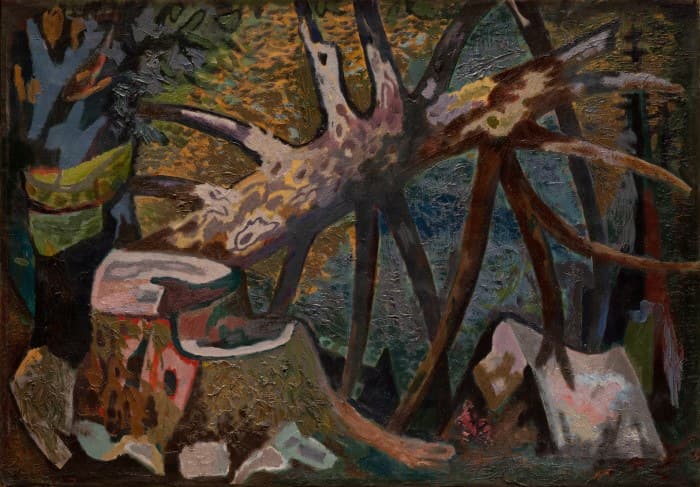
Windfall
A Carpathian forest floor of storm-thrown spruce, the shattered trunks flattened into pale calligraphic shapes against a dense dark green ground worked in heavy impasto. Bought by the gallery directly from Selskyi in 1980.
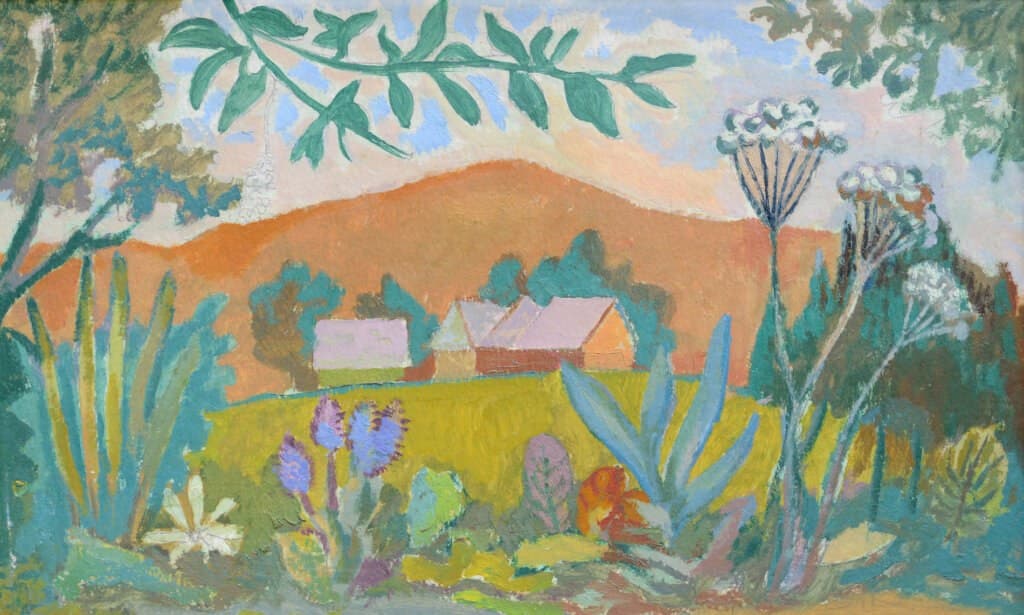
Houses in Chornohora
Highland houses in the Chornohora range, from the Carpathian series Selskyi worked on for three decades, reduced to blocks of colour and roofline. Shown repeatedly in NU ART's Selskyi retrospectives, including 'Roman Selskyi. Modernism and Magic' (2018) and his 120th-anniversary exhibition (2023).
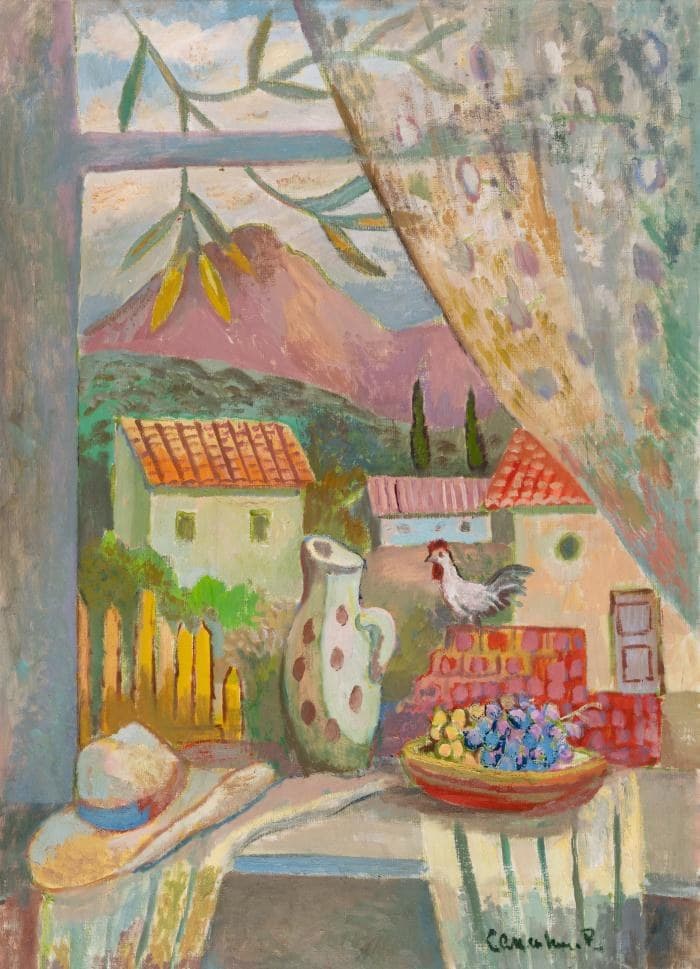
Crimean Window
A window motif that fuses still life and landscape: a spotted jug, a bowl of grapes and a straw hat on a table in front of an open frame giving onto tiled roofs, a rooster, cypresses and a pink Crimean mountain. Donated to the gallery by Selskyi himself in 1984.
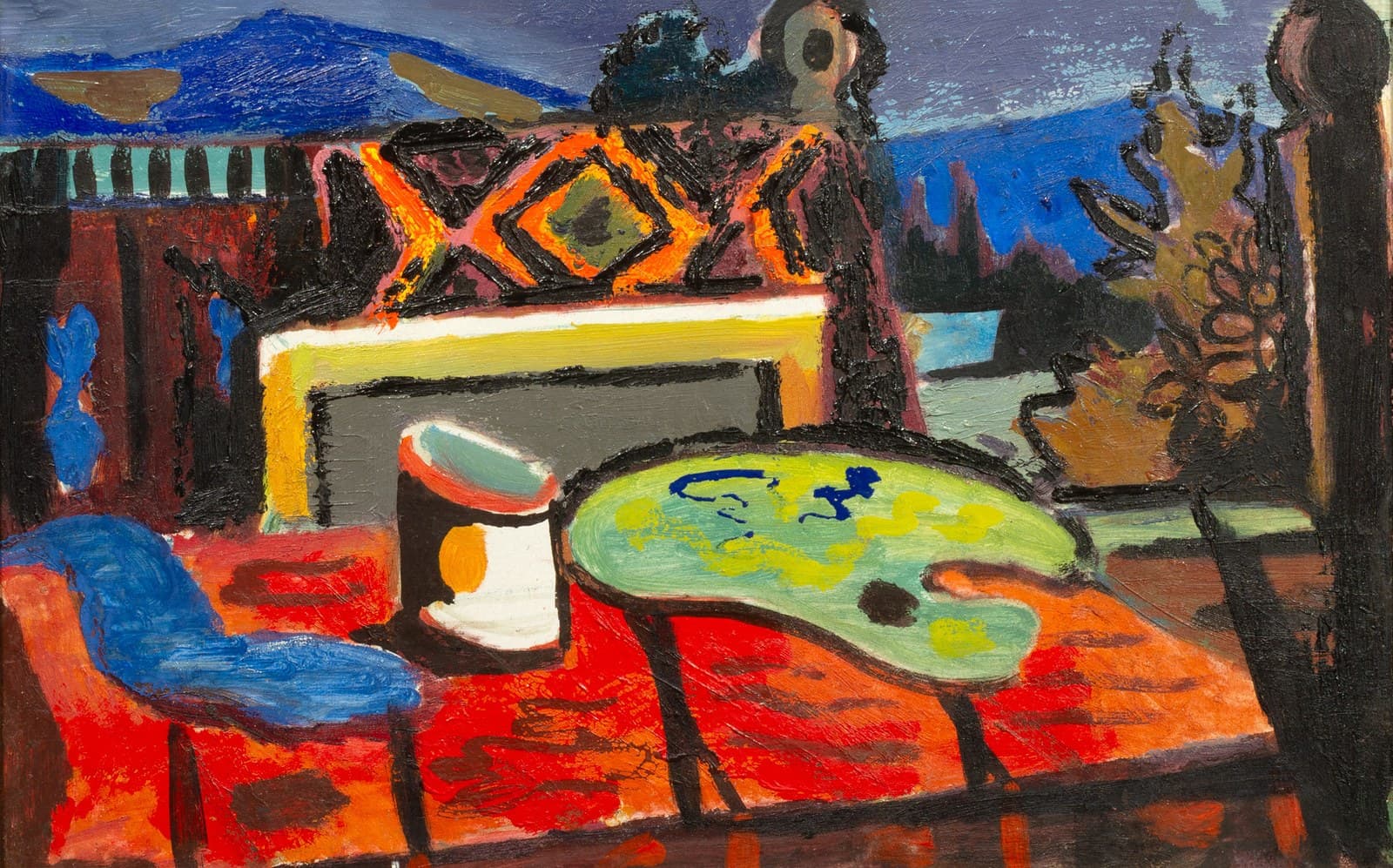
Still Life with a Palette
A studio still life built around the painter's own palette, the tool turned into subject, worked in the thick, tactile impasto and deliberately weighed colour relationships of Selskyi's mature manner. Signed lower right; catalogued by the Goldens auction house as 1970s rather than a single year.