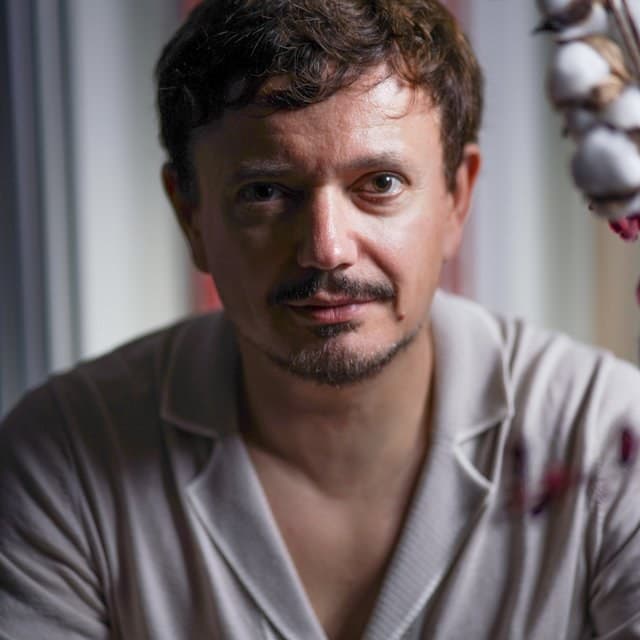
Oleh Savka is a contemporary Ukrainian painter, designer and architect who lives in the old town of Kyiv and paints its streets, courtyards and churches with a palette knife. Trained as a furniture and interior designer, he turned intensively to painting in 2022 and by early 2026 had completed some ninety-nine canvases.
Oleh Savka works between design and painting, and describes the two as inseparable in his life. He took a Bachelor of Arts in design at the Ukrainian National Forestry University in 2002, training as a furniture and interior designer on a course that also taught drawing, painting and sculpture, and he has practised as a designer and architect. From 2022 he began painting intensively: his first Kyiv canvas was the view of the courtyard from his own apartment window, and by March 2026 he had produced ninety-nine works and was at work on the hundredth. He paints in oil with a mastikhin — a palette knife — which gives thick, loaded strokes and physical relief but makes fine detail and colour balance harder to control; a 40 × 30 cm canvas takes him a day to a day and a half. He walks the city looking for an angle, photographs it, then transfers the composition to canvas. His subjects are almost all old Kyiv — Podil, the Golden Gate, the Pidhorskyi house known as the "Baron's Castle" — often setting the historical against the contemporary, and he explicitly aligns himself with the Impressionist conviction that what matters is not what is depicted but how. He is associated with Lviv as well as Kyiv, has shown in more than thirty solo exhibitions of painting and graphic art including in Kyiv, Paris, Kraków and Warsaw, and four of his works represented Ukraine at the Days of Ukraine in Luxembourg. He lists internationally under the transliteration "Oleg Savka" and titles his marketplace works in English.
Portrait: photograph sourced from saatchiart.com. © the photographer / rights holder; shown for editorial purposes. Contact us for attribution or removal.
Art Movements
Impressionism
Impressionism was a 19th-century French art movement (1870s-1880s) that revolutionized Western art by capturing fleeting moments and the shifting effects of light using visible brushstrokes, open composition, and vibrant colors. Focusing on modern life and landscapes, key artists included Claude Monet, Pierre-Auguste Renoir, Camille Pissarro, and Berthe Morisot. Usage Examples & Characteristics: Plein Air Painting: Painting outdoors to capture natural light, such as Monet’s studies of Rouen Cathedral or haystacks in varying weather conditions. Visible Brushwork: Thick, rapid, or broken brushstrokes intended to convey a sense of motion and the ephemeral nature of a scene. Everyday Subjects: Depicting leisure activities, urban life in Paris, or landscapes rather than historical or mythological scenes. Unusual Visual Angles: Inspired by photography, artists like Degas used candid-style, unconventional framing of subjects, such as dancers or laundresses. "Impressionist Music": A similar approach in music and dance, focusing on mood and atmosphere over rigid structure, with artists like Claude Debussy and Maurice Ravel.
Explore movement →Post-Impressionism
Post-Impressionism (c. 1886–1905) was a French art movement that reacted against the limitations of Impressionism, favoring emotional expression, symbolic content, and structural order over realistic light depiction. Key artists included Cézanne, Van Gogh, Gauguin, and Seurat, who used vivid, unnatural colors and thick paint application to create unique styles that paved the way for modern art. Key Characteristics Symbolic and Emotional Content: Pushing beyond the objective recording of nature to express subjective emotions and symbolic meaning. Structural Order: A move away from fleeting moments toward, as Paul Cézanne aimed, making of Impressionism "something solid and durable, like the art of the museums". Vivid, Non-Naturalistic Color: Using color for emotional or decorative impact rather than just representing natural light. Distinctive Techniques: Examples include Seurat's Pointillism (tiny, systematic dots of color) and Van Gogh's expressive, swirling brushwork.
Explore movement →1991–presentContemporary Ukrainian Painting
Painting made in independent Ukraine, from the 1991 declaration of independence onward. It is pluralist rather than programmatic: plein-air landscape and psychological portraiture continue alongside conceptual, minimalist and symbolist strands, with a marked turn after 2014 and especially after 2022 toward wartime subjects, national memory and the vernacular Ukrainian village.
Explore movement →Works by Oleh Savka
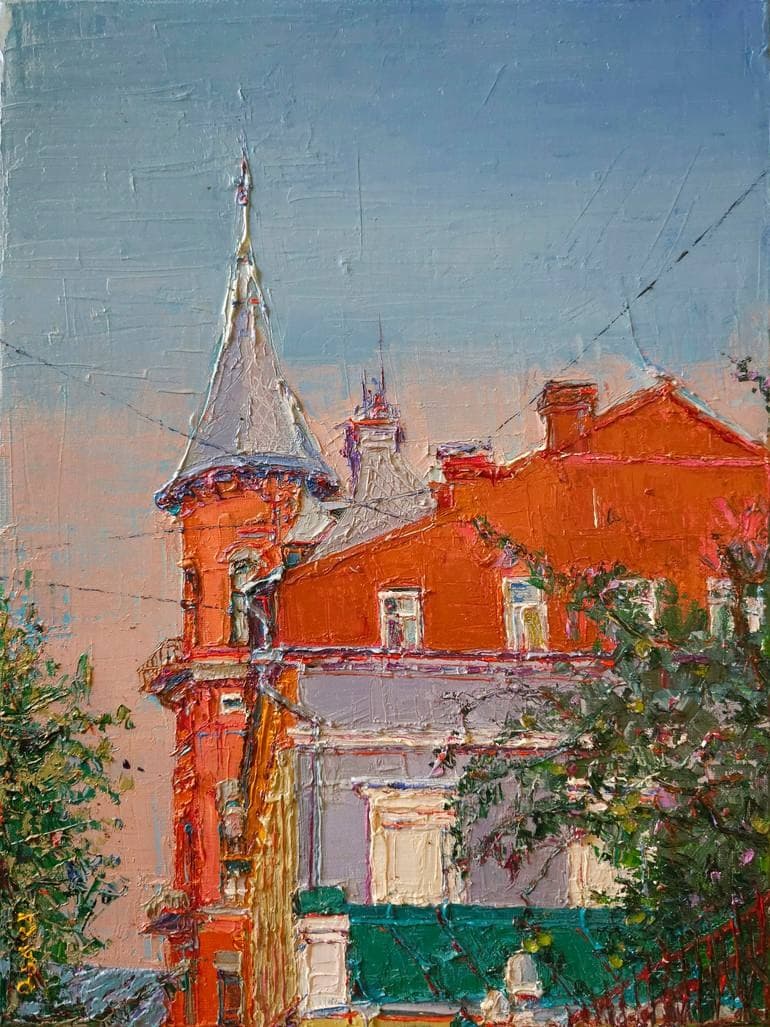
Late Afternoon
The Pidhorskyi house in Kyiv — popularly the "Baron's Castle" — half hidden behind the building in front of it, its turrets caught in late light. Painted with a palette knife in heavy relief.
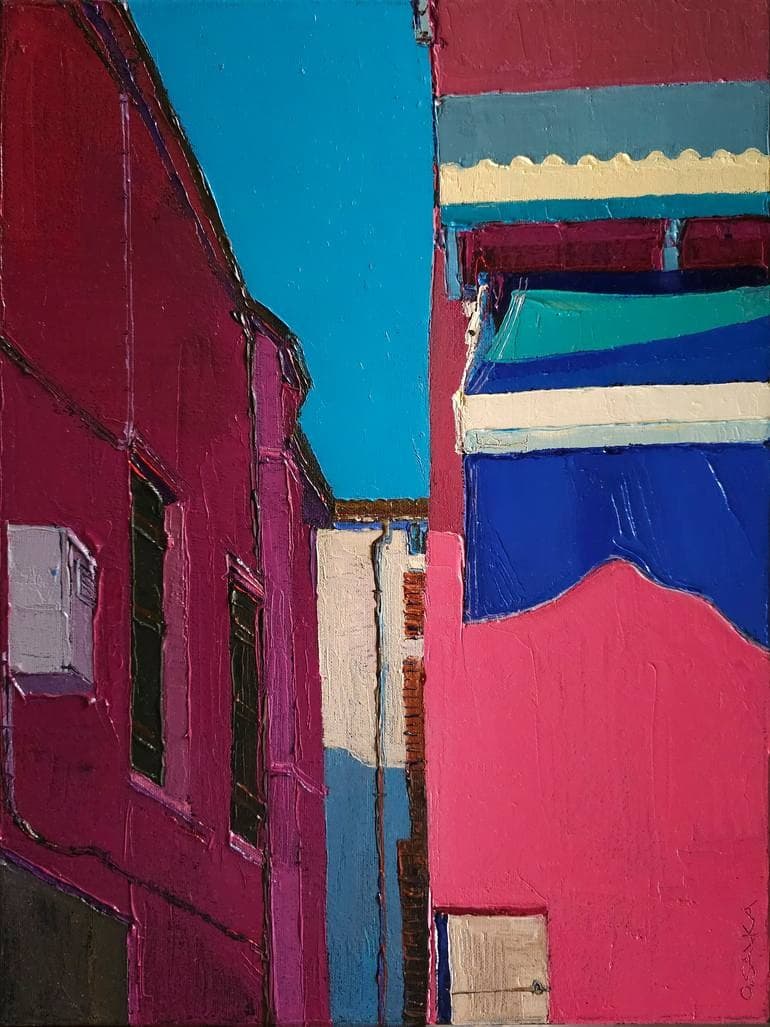
Somewhere in the South
A sun-struck southern street corner, with the light burning across one edge of an awning. The artist notes that its warm, bright colour deliberately suggests an old southern city — Italy, Spain or Greece.
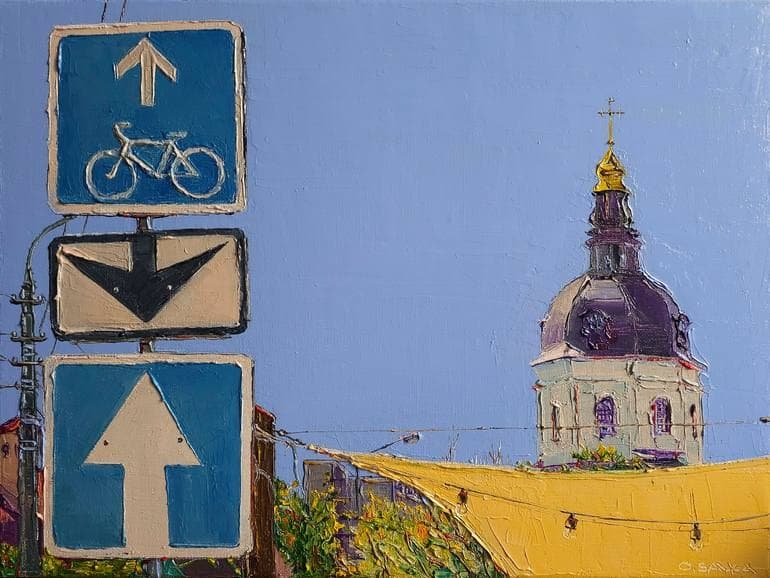
The Annunciation
Old Podil in golden light with the dome of the Church of the Annunciation at the Kyiv-Mohyla Academy behind it. The artist dedicated the painting to the events in Sumy of 13 April 2025: "We will not forget. We will not forgive."