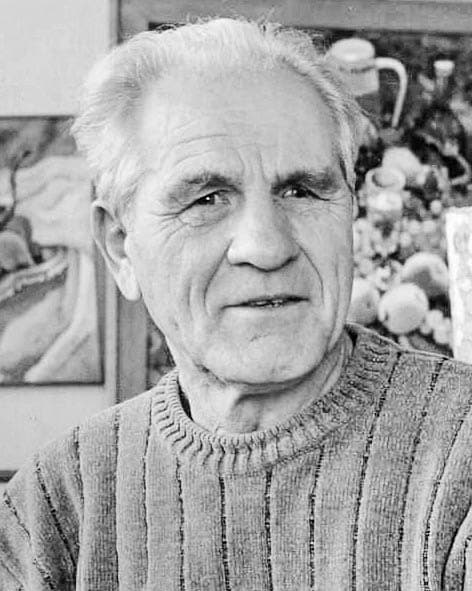
Mykola Maksymenko
Микола Максименко
1924–2016 · Yaropovychi, Andrushivka raion, Zhytomyr oblast, Ukraine
Mykola Maksymenko was a Ukrainian painter of still lifes and landscapes, People's Artist of Ukraine (1994) and a laureate of the Shevchenko National Prize for his cycle 'Landscapes of Ukraine'. Blinded in one eye as a front-line scout in 1943, he spent nearly seven decades painting the Polissia countryside around Zhytomyr in a dense, high-keyed impasto. The largest single collection of his work is held by the Zhytomyr Regional Museum of Local Lore.
Mykola Antonovych Maksymenko was born on 31 December 1924 into a peasant family in the village of Yaropovychi in the Andrushivka raion of Zhytomyr oblast, and took his first lessons in oil painting from a visiting Kyiv artist, A. T. Osadchy. At eleven he copied a portrait of Taras Shevchenko and displayed it in a window above his family's veranda door — his first, village-wide 'exhibition'. Fleeing the famine, the family moved to Magnitogorsk in the Urals in 1938, where he studied in the art studio of Borys Dehtiarov in 1941–1942 before entering the Tallinn Military Infantry College; sent to the front in 1943, he was hit by shell fragments near the Dnieper and permanently lost the sight of his left eye, after which he disliked using open red. Between 1947 and 1948 he travelled from Magnitogorsk to Moscow to study under Igor Grabar, then returned to Ukraine in 1948 to head the art studio of the Palace of Pioneers in Rivne, settling in Zhytomyr in 1949 as a fine-arts consultant at the House of Folk Creation. He was admitted to the Artists' Union in 1960, served as artist-in-chief of the Zhytomyr Art Studios from 1965 to 1975, was named an Honoured Artist in 1974 and People's Artist of Ukraine in 1994, and in 1994 received the Taras Shevchenko State Prize of Ukraine for his series of Ukrainian landscapes. He kept close creative ties with Mykola Hlushchenko, Serhii Shyshko and Tetiana Yablonska, and the Latvian critic Halyna Karklin wrote of him in 1971 that she had never before met 'such a master of the monumental register of the still life'. He organised fourteen solo exhibitions between 1960 and 2004 and painted on open-air expeditions in Crimea, the Carpathians and across northern Ukraine; his work entered museums in Ukraine and collections in Japan, Cyprus, France, Italy, Poland and Bulgaria. He died in Zhytomyr on 11 September 2016.
Art Movements
Realism
Realism is an artistic movement that sought to depict reality as accurately and objectively as possible, holding that the purpose of art is to reflect all aspects of existence, rather than merely its idealized representation. The term was introduced by the French literary critic Jules Champfleury in the 1850s to denote art that opposed Romanticism and Academicism. In the visual arts, the significance of Realism as a style is quite controversial, and its boundaries are undefined. In a narrower sense, realism is understood as positivism, a movement in the visual arts of the second half of the 19th century. One of the first realists was the French artist Gustave Courbet (1819–1877), who opened his solo exhibition “The Pavilion of Realism” in Paris in 1855. Before him, artists of the Barbizon School—Théodore Rousseau, Jean-François Millet, and Jules Breton—worked in a realistic style. In the 1870s, realism split into two main movements: naturalism and impressionism. In contemporary painting, realism borders on the grotesque and anti-glamour.
Explore movement →Post-Impressionism
Post-Impressionism (c. 1886–1905) was a French art movement that reacted against the limitations of Impressionism, favoring emotional expression, symbolic content, and structural order over realistic light depiction. Key artists included Cézanne, Van Gogh, Gauguin, and Seurat, who used vivid, unnatural colors and thick paint application to create unique styles that paved the way for modern art. Key Characteristics Symbolic and Emotional Content: Pushing beyond the objective recording of nature to express subjective emotions and symbolic meaning. Structural Order: A move away from fleeting moments toward, as Paul Cézanne aimed, making of Impressionism "something solid and durable, like the art of the museums". Vivid, Non-Naturalistic Color: Using color for emotional or decorative impact rather than just representing natural light. Distinctive Techniques: Examples include Seurat's Pointillism (tiny, systematic dots of color) and Van Gogh's expressive, swirling brushwork.
Explore movement →Works by Mykola Maksymenko
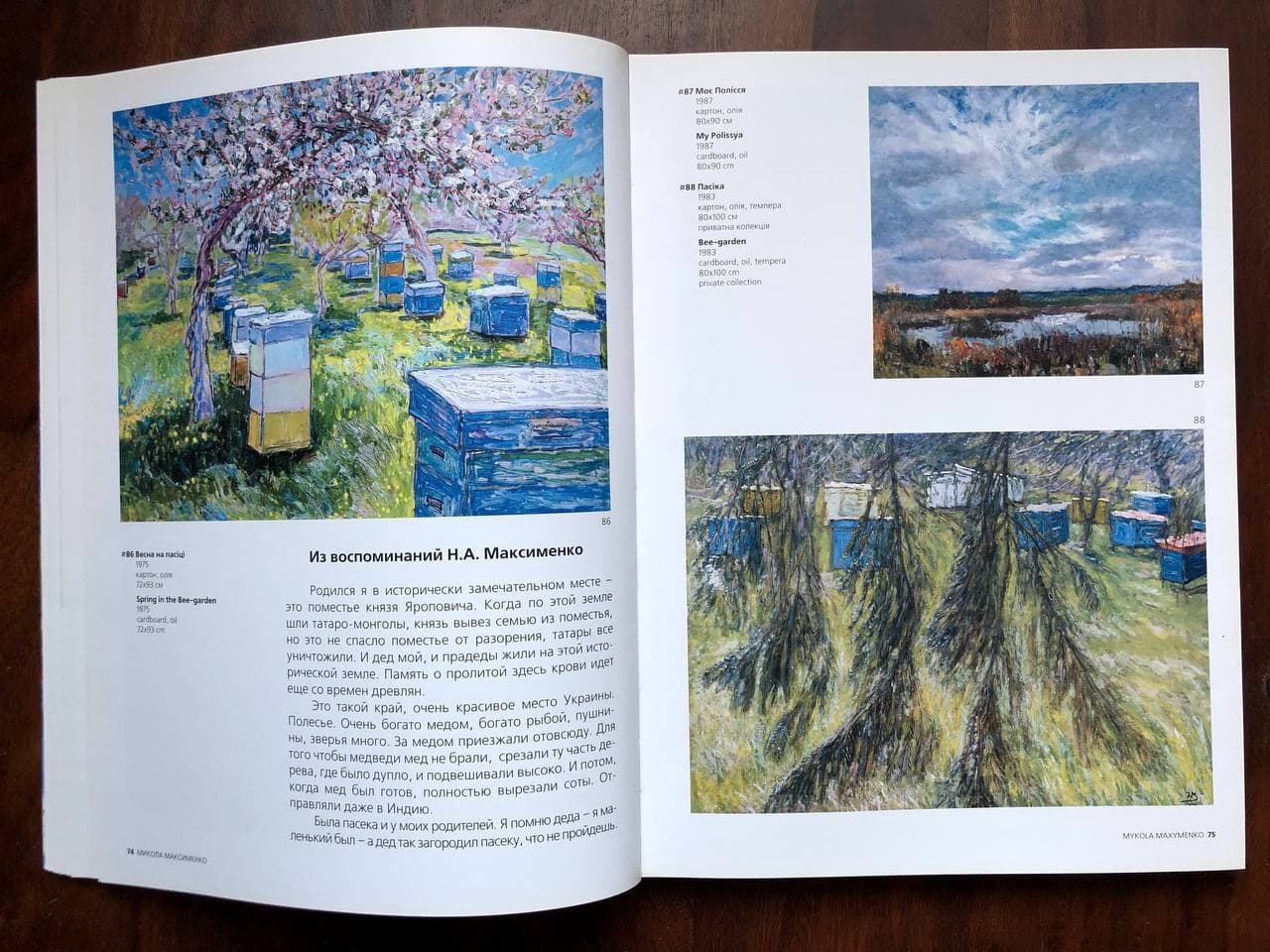
Spring in the Bee-garden
Painted hives stand under a cherry tree in full blossom, the whole surface built from short loaded strokes of pink, blue and acid green. Catalogue entry #86 in the artist's 2007 monograph.
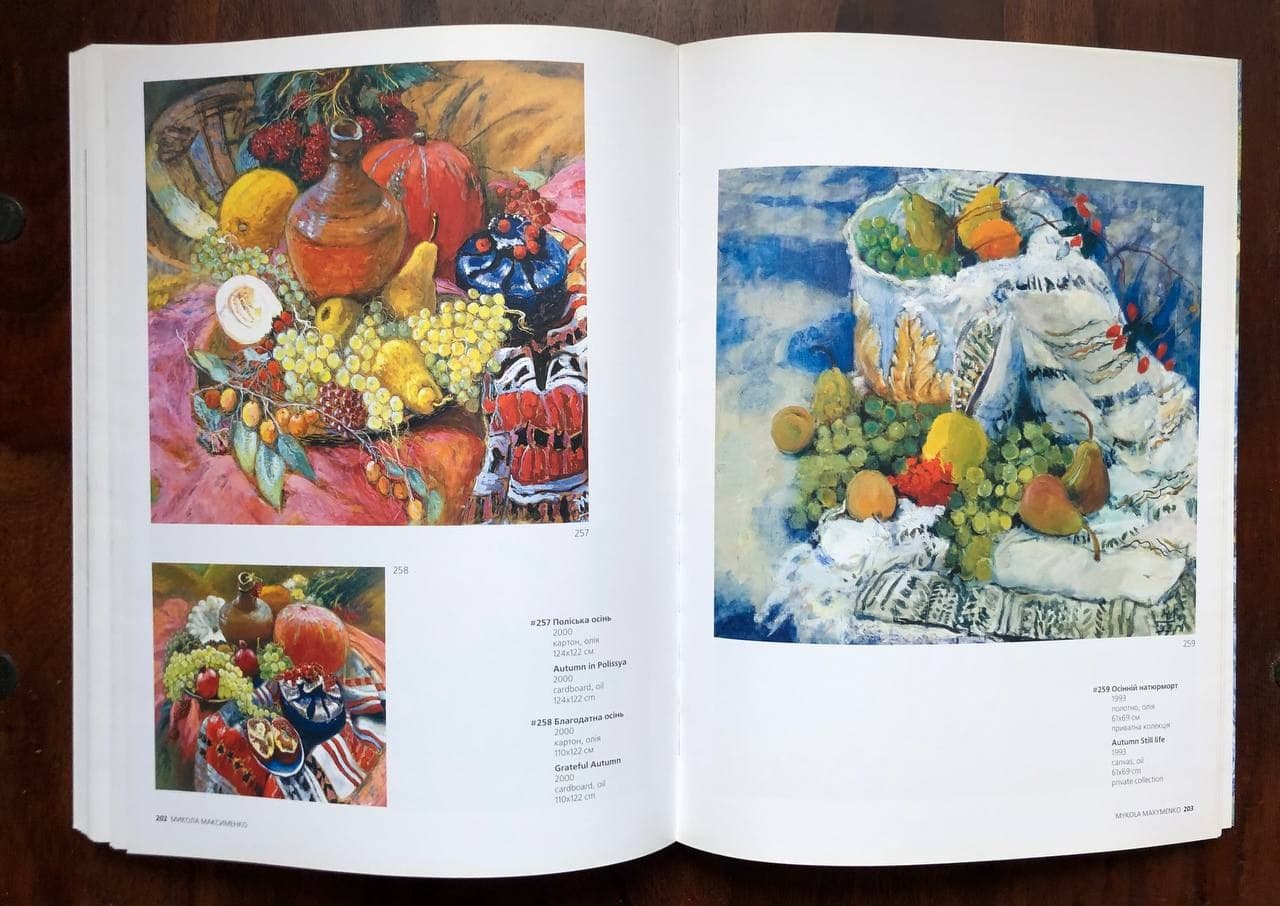
Autumn Still Life
Pears, grapes, apricots and rose hips piled on a heavy embroidered towel against a cold blue ground — a characteristic example of what critics called Maksymenko's monumental treatment of the still life. Catalogue entry #259.
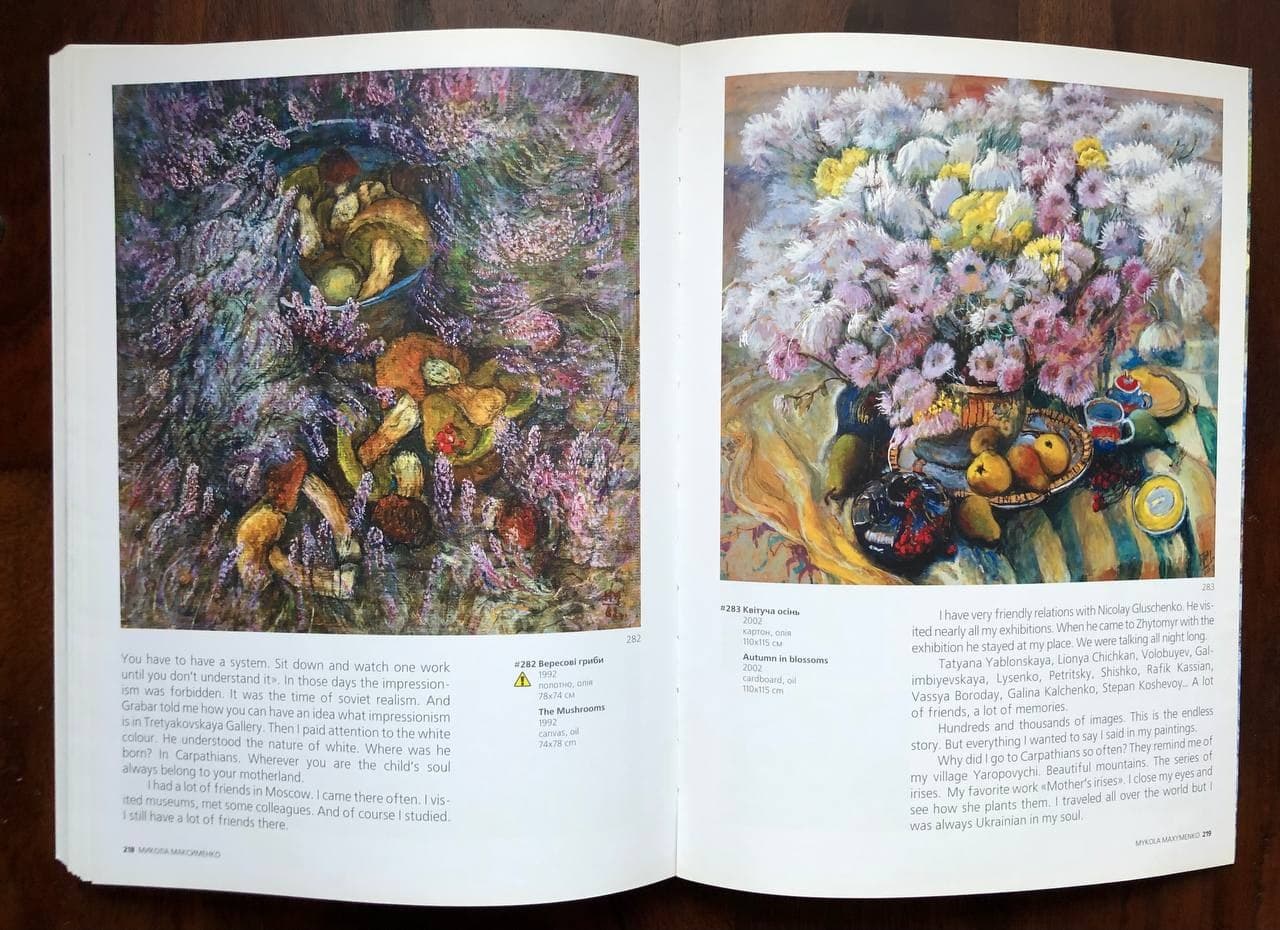
Autumn in Blossoms
A late, almost hallucinatory bouquet of pale chrysanthemums crowding over a table of fruit and painted ceramics, made when the artist was seventy-seven. Catalogue entry #283.