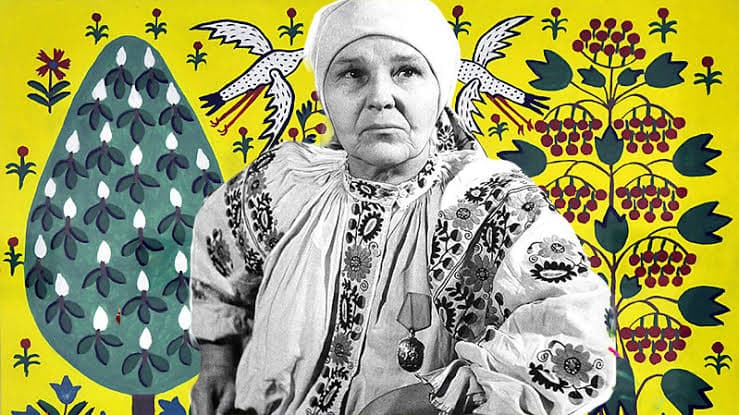
Mariia Prymachenko
Марія Оксентіївна Примаченко
1909–1997 · Bolotnia, Kyiv Governorate, Russian Empire (now Ivankiv district, Kyiv Oblast, Ukraine)
Mariia Prymachenko was a Ukrainian folk painter and the best-known figure of twentieth-century Ukrainian naive art. Working in gouache and watercolour on paper, she invented a bestiary of fantastical animals and personified flowers that has become a national visual emblem. She spent almost her whole life in her native village of Bolotnia, north of Kyiv.
Mariia Oksentiivna Prymachenko was born on 12 January 1909 (30 December 1908 O.S.) in Bolotnia, a Polissian village in Kyiv Governorate, to a carpenter father and an embroiderer mother. Polio in childhood left her with a permanent difficulty walking, and researchers of her work often connect that early confinement with the extraordinary intensity of her invented imagery. She had no academic training; in 1936 she was invited to the Central Experimental Workshops at the Kyiv Museum of Ukrainian Art, where she worked alongside Anatol Petrytskyi and Vasyl Krychevskyi, and the same year her series "Beasts of Bolotnia" won a first-class diploma at the All-Ukrainian Exhibition of Folk Art. Her work was shown in Moscow, Warsaw, Sofia, Prague and Montreal, and won a gold medal at the 1937 Paris International Exposition. Her husband died in the Second World War, and she raised their son Fedir, who became a folk artist in turn, alone in Bolotnia. She worked in gouache and watercolour, unifying drawing and painting into what critics called "painterly graphics": saturated non-white grounds filled with rhythmic rows of dots, arcs and small marks, and large flattened animal forms whose bodies carry ornament like embroidery. Her signature beasts — the Wild Chaplun, the Pea Beast, the Blue Bull, the sunny lions — belong to no folk canon but to her own invented mythology of the struggle between good and evil, and her late Chornobyl cycle turned that mythology into open political protest. She received the Shevchenko Prize in 1966, the title People's Artist of Ukraine in 1988, and UNESCO declared 2009 the Year of Maria Prymachenko; she died in Bolotnia on 18 August 1997. Approximately 650 of her more than 800 surviving works are held by the National Museum of Ukrainian Folk Decorative Art in Kyiv, while some twenty-five works burned with the Ivankiv Historical Museum on 27 February 2022 during the Russian advance on Kyiv.
Art Movements
Folk Decorative Art
Folk decorative art is the visual language of a community, traditionally created by untrained artisans rather than academic artists. It combines utility with ornament, transforming everyday objects like furniture, textiles, and tools into works of cultural expression.
Explore movement →20th century – presentNaive Art
A current of self-taught, non-academic painting in which artists without formal training build highly personal pictorial worlds out of folk memory, religious imagery, dreams and invented flora and fauna. In Ukraine it is the tradition of Kateryna Bilokur, Maria Prymachenko and Polina Raiko: flat, ornamentally organised, intensely coloured compositions that reject perspective and academic modelling in favour of rhythm, pattern and symbolic narrative. Ukrainian naive art is closely intertwined with village decorative painting, and after 2022 became a widely used emblem of national cultural resilience.
Explore movement →Works by Mariia Prymachenko
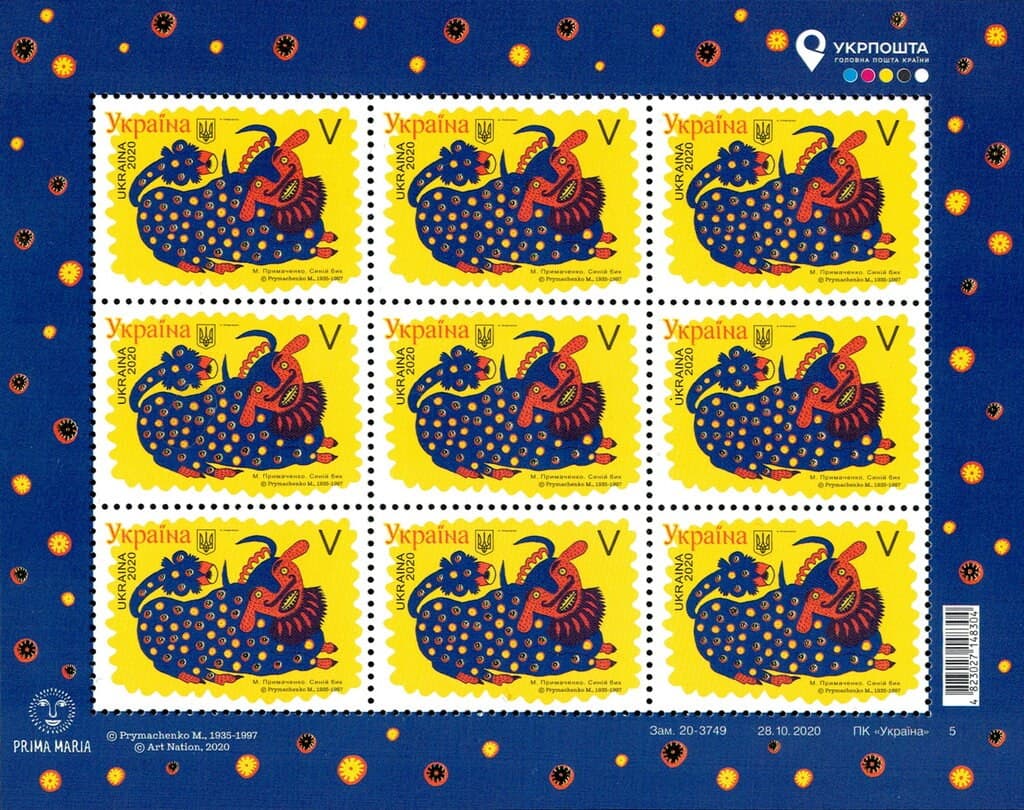
Blue Bull
An early post-war beast painting in which a deep blue bull stands against an ornamented ground, one of the works that established Prymachenko's mature idiom. Ukrposhta reproduced it on a 2020 stamp sheet marking the Year of the Ox.
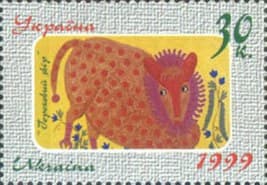
Pea Beast
A fantastical creature whose body is covered with pea-like ornament, from the animal series in which Prymachenko gave invented beasts human eyes and an ambiguous moral character. Issued as one of the two 1999 Ukrposhta stamps honouring the artist.
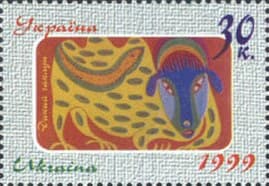
Wild Chaplun
One of Prymachenko's invented beasts, named from the verb "chapaty" (to trudge) and built around enormous clawed feet able to push through the thickets of life. Reproduced on the 1999 Ukrposhta stamp pair dedicated to the artist.
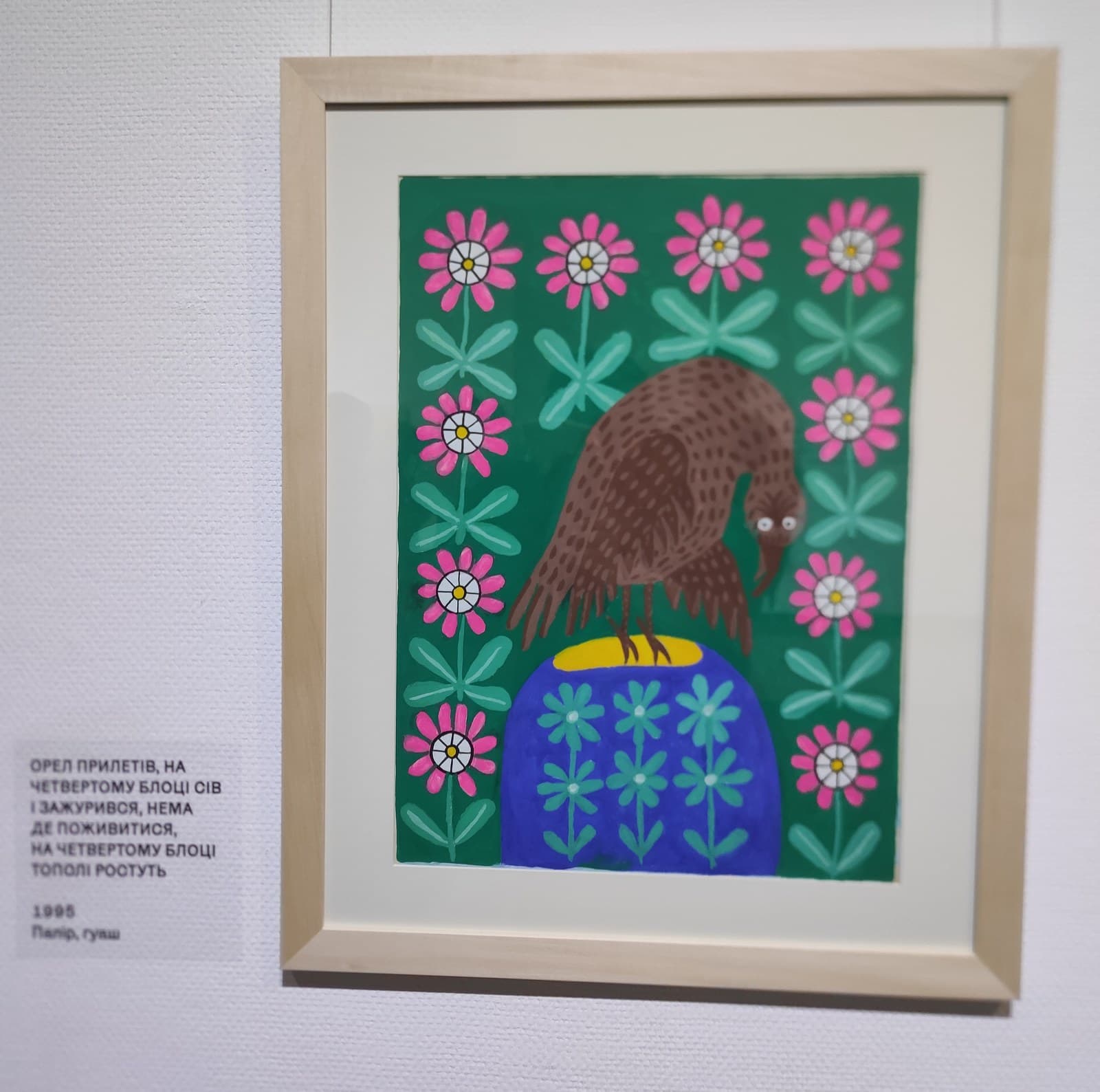
Eagle at the Fourth Block
Part of Prymachenko's Chornobyl cycle, in which a great bird presides over the ruined fourth reactor block; the same cycle produced "Flowers Grew Near the Fourth Block" (1990). Photographed at the 2023 Kyiv exhibition of a hundred works never previously shown in public.