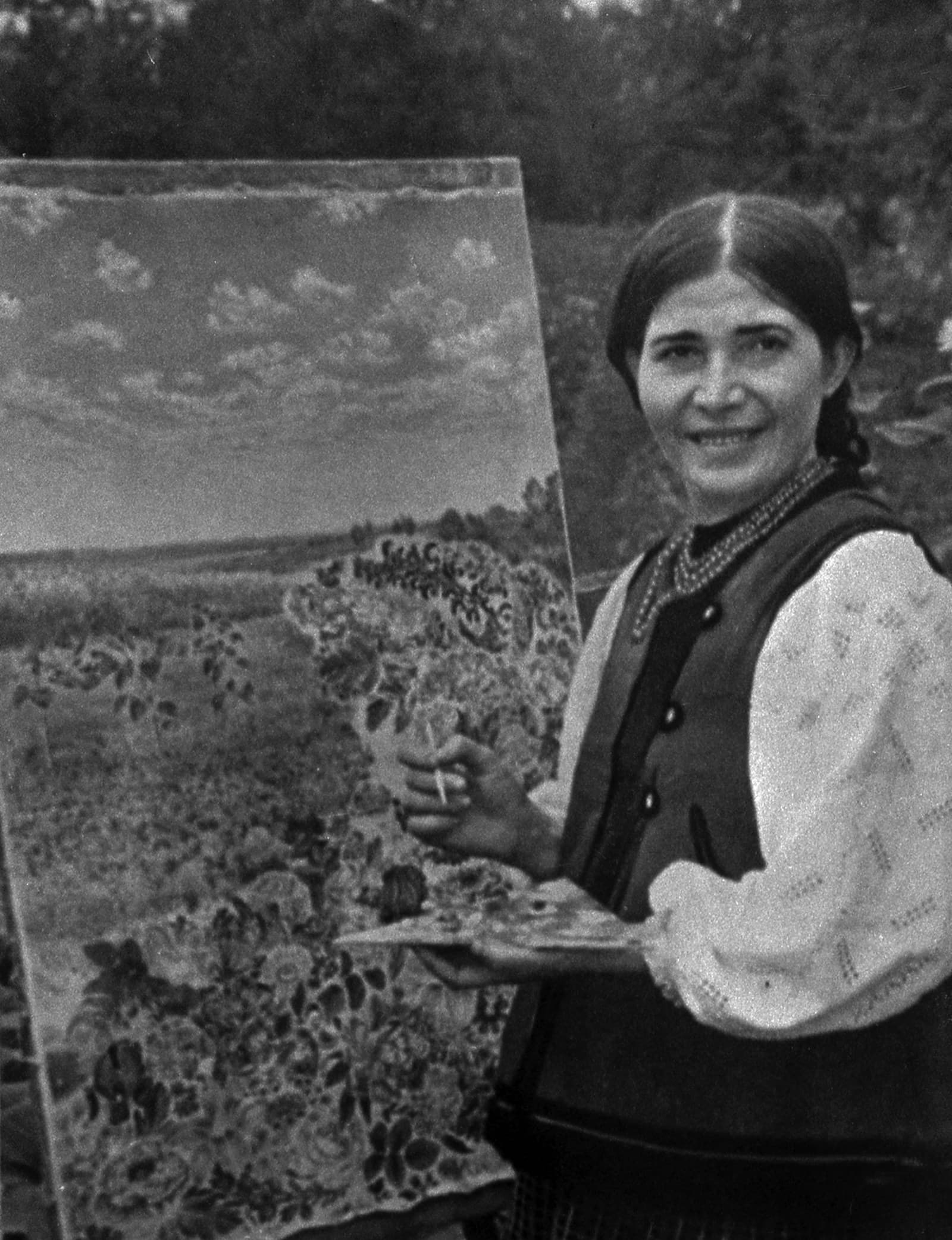
Kateryna Bilokur
Катерина Білокур
1900–1961 · Bohdanivka, Piriatyn uezd, Poltava Governorate (now Kyiv Oblast, Ukraine)
Kateryna Bilokur was a self-taught peasant painter from the Poltava region who became one of the great figures of Ukrainian folk decorative art, working almost entirely in oil on canvas without ever attending an art school. Refused entry to art colleges twice for lacking a school certificate, she painted in secret against her family's opposition, making her own brushes from cat and cow hair and cherry twigs. Her densely worked flower compositions on deep blue grounds brought her national recognition from 1940 onwards and are now the core of the collection of the National Museum of Ukrainian Folk Decorative Art in Kyiv.
Kateryna Bilokur was born in 1900 in the village of Bohdanivka in Poltava Governorate to a moderately prosperous peasant family who decided against sending her to school to save on shoes and clothes. She taught herself to draw on stolen scraps of homespun canvas with charcoal, hiding the work from parents who saw it as a threat to her chances of marriage; she was turned away from the Myrhorod ceramics technicum around 1922–1923 and from the Kyiv theatre technicum in 1928, both times for lacking a seven-year school certificate, and walked home from Myrhorod on foot. After an attempted drowning in the river Chumhak in 1934 her father relented and allowed her to paint. Her career began in 1940 when she sent a drawing of a guelder rose on a piece of canvas to the singer Oksana Petrusenko, who showed it to Vasyl Kasiian and Pavlo Tychyna; a solo exhibition of eleven pictures followed in Poltava that year, and in 1944 the director of the State Museum of Ukrainian Folk Decorative Art, Vasyl Nahai, began buying her work, which is why that museum now holds the finest collection of it. Technically she is closer to an embroiderer than to an easel painter: she made her own needle-fine brushes, laid a flat ultramarine or cobalt ground and then built flowers over it one at a time, sometimes across a whole season so that spring and autumn blooms appear in the same picture, and she stretched canvas onto a reused frame with twine like cloth in an embroidery hoop. Three of her paintings — 'Tsar Kolos', 'Birch' and 'Collective Farm Field' — went into the Soviet section of the 1954 international exhibition in Paris, where Pablo Picasso is widely reported to have compared her to Séraphine Louis. She was named People's Artist of the Ukrainian SSR in 1956 but remained in Bohdanivka, corresponding with Tychyna, the art historian Stefan Taranushenko and the artist Olena Kulchytska, and teaching a handful of local pupils. She died in June 1961 in the Yahotyn district hospital after an operation, weeks after her mother's death, and is buried in Bohdanivka under a gravestone by the sculptor Ivan Honchar; her house became a memorial museum in 1977, and a crater on Mercury was named after her in 2024.
Art Movements
Folk Decorative Art
Folk decorative art is the visual language of a community, traditionally created by untrained artisans rather than academic artists. It combines utility with ornament, transforming everyday objects like furniture, textiles, and tools into works of cultural expression.
Explore movement →20th century – presentNaive Art
A current of self-taught, non-academic painting in which artists without formal training build highly personal pictorial worlds out of folk memory, religious imagery, dreams and invented flora and fauna. In Ukraine it is the tradition of Kateryna Bilokur, Maria Prymachenko and Polina Raiko: flat, ornamentally organised, intensely coloured compositions that reject perspective and academic modelling in favour of rhythm, pattern and symbolic narrative. Ukrainian naive art is closely intertwined with village decorative painting, and after 2022 became a widely used emblem of national cultural resilience.
Explore movement →Works by Kateryna Bilokur
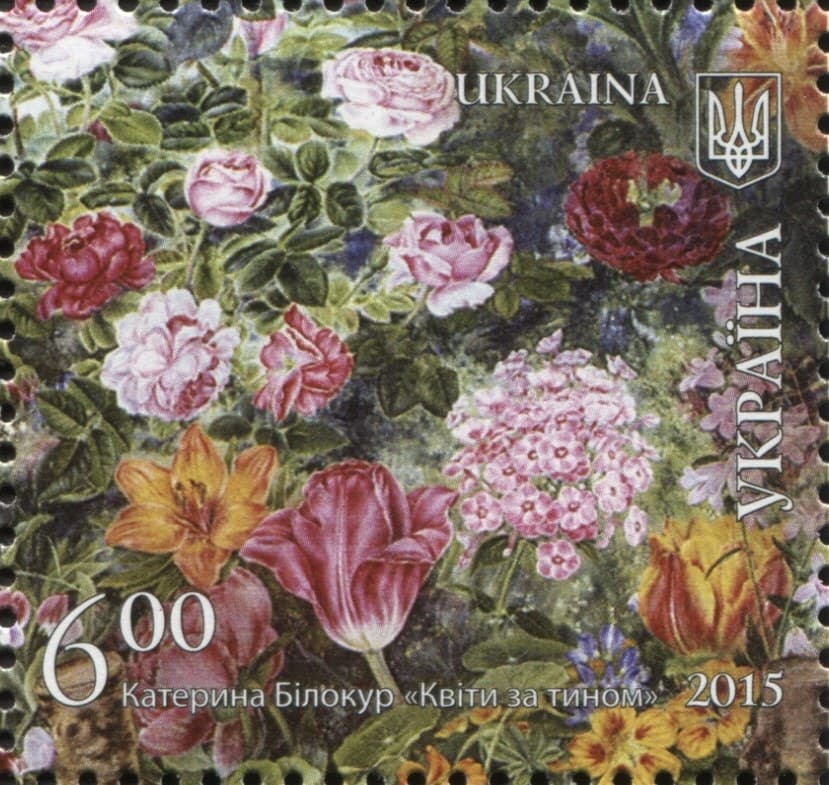
Flowers Behind the Fence
One of Bilokur's earliest surviving flower compositions, a wall of roses, phlox, lilies and tulips pressing forward out of a dark garden so densely that no single light source can be found in it. Ukrposhta reproduced it in full bleed on a 2015 stamp.
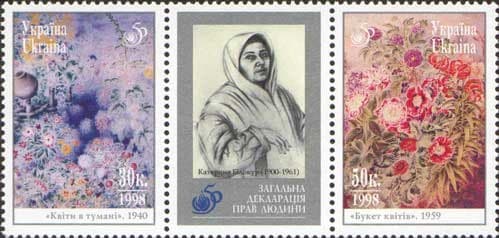
Flowers in the Mist
Painted in the year Bilokur was first exhibited, a pale, softly dissolved flower thicket in which the blooms surface out of a silvered haze instead of standing against her usual flat blue ground. It appeared on a Ukrposhta stamp strip issued in 1998.
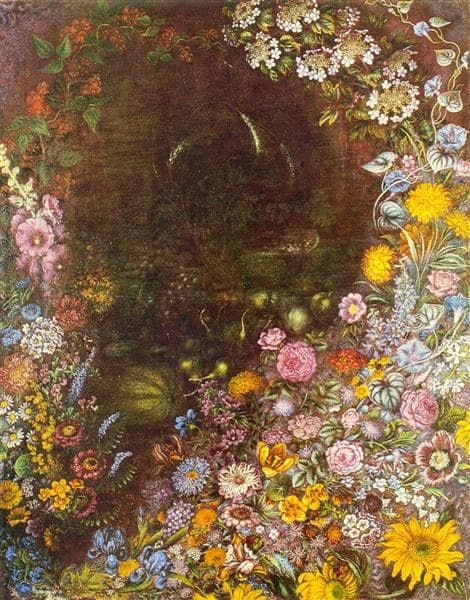
Tsar Kolos
Bilokur's best-known painting: ripe golden ears of wheat reigning at the centre of a deep brown ground, ringed by flowers and fruit. It was one of three works sent to the Soviet section of the 1954 international exhibition in Paris, where Picasso is reported to have praised her.
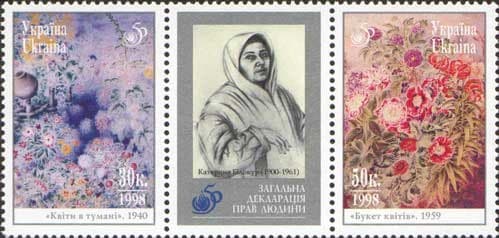
Bouquet of Flowers
A late massed bouquet of roses, peonies and phlox in the hot pink-and-crimson register of Bilokur's final years, painted two years before her death. It is the second of the two Bilokur paintings reproduced on Ukrposhta's 1998 stamp strip.