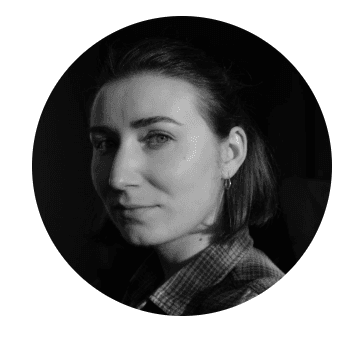
Ilona Shymchyts
Ілона Шимчиць
· Mushkativka, Borshchiv district, Ternopil Oblast, Ukraine
Ilona Shymchyts is a Ukrainian painter and relief-carver from the Borshchiv district of Ternopil Oblast, trained at the Lviv National Academy of Arts and based in Lviv. Her work moves between geometric abstraction in acrylic on paper and quiet, meditative rural landscapes in which village architecture carries a sense of calm and rootedness. She has shown in Kyiv, Kharkiv, Lviv and Borshchiv as well as in Canada and Poland.
Ilona Vitaliivna Shymchyts comes from the village of Mushkativka in the Borshchiv district of Ternopil Oblast and was educated at the Lviv National Academy of Arts, where her painting-department diploma projects were the exhibition project «Вихід. Буття.» (Exit. Being.) and the painting-and-installation «Сад» (Garden), the latter addressing the depiction of war in twentieth- and twenty-first-century art. She lives and works in Lviv. Her practice divides into two strands. The first is a conceptual, minimalist abstraction on paper — works such as "Spectrum" (2018), built from twelve coloured triangles and a scatter of circles read as reflections of a single circle, and "Spiritus oceanum" (2021), acrylic on paper finished with matte varnish. She has also made relief sculpture, beginning the "Labyrinths" series in 2020 from wooden blocks of differing heights with filigree carving and acrylic paint. The second strand, dominant in her recent output, is landscape: small and mid-size acrylics on canvas of fields, cattle, snow-covered roofs and abandoned village houses, combining a realist attention to detail with a soft decorative quality and a deliberately restrained palette. Her work has been exhibited in Kyiv, Kharkiv, Lviv and Borshchiv, at the L. Levytskyi Museum in Burdiakivtsi, and abroad in Toronto, Poznań and Toruń. It is held in private collections in Ukraine, the United States, Poland, Germany, the United Kingdom, France and the Czech Republic, and is distributed internationally through Saatchi Art and Artsper.
Art Movements
Realism
Realism is an artistic movement that sought to depict reality as accurately and objectively as possible, holding that the purpose of art is to reflect all aspects of existence, rather than merely its idealized representation. The term was introduced by the French literary critic Jules Champfleury in the 1850s to denote art that opposed Romanticism and Academicism. In the visual arts, the significance of Realism as a style is quite controversial, and its boundaries are undefined. In a narrower sense, realism is understood as positivism, a movement in the visual arts of the second half of the 19th century. One of the first realists was the French artist Gustave Courbet (1819–1877), who opened his solo exhibition “The Pavilion of Realism” in Paris in 1855. Before him, artists of the Barbizon School—Théodore Rousseau, Jean-François Millet, and Jules Breton—worked in a realistic style. In the 1870s, realism split into two main movements: naturalism and impressionism. In contemporary painting, realism borders on the grotesque and anti-glamour.
Explore movement →Modernism
Modernism was a radical, early-to-mid-20th-century cultural movement that broke with traditional artistic, literary, and social forms to align with a rapidly industrializing world. Characterized by experimentation, abstraction, and individualism, it sought new modes of expression to address themes of alienation and social change following World War I. Rejection of Tradition: Modernists rejected Victorian morality, academic art, and realistic depictions of subjects, seeking to "make it new". Experimentation: A shift towards abstraction in art (e.g., Cubism) and new techniques in literature, such as stream of consciousness (e.g., Virginia Woolf, James Joyce). Key Themes: Focused on subjectivity, alienation, the fragmentation of reality, and the quest for new meaning. Architecture & Design: Marked by minimalism, functionalism, and the use of industrial materials, famously summarized by Le Corbusier’s "a building is a machine for living in". Time Period: Roughly 1890s–1960s, emerging in Europe and America as a response to urbanization and technological advances.
Explore movement →1991–presentContemporary Ukrainian Painting
Painting made in independent Ukraine, from the 1991 declaration of independence onward. It is pluralist rather than programmatic: plein-air landscape and psychological portraiture continue alongside conceptual, minimalist and symbolist strands, with a marked turn after 2014 and especially after 2022 toward wartime subjects, national memory and the vernacular Ukrainian village.
Explore movement →Works by Ilona Shymchyts
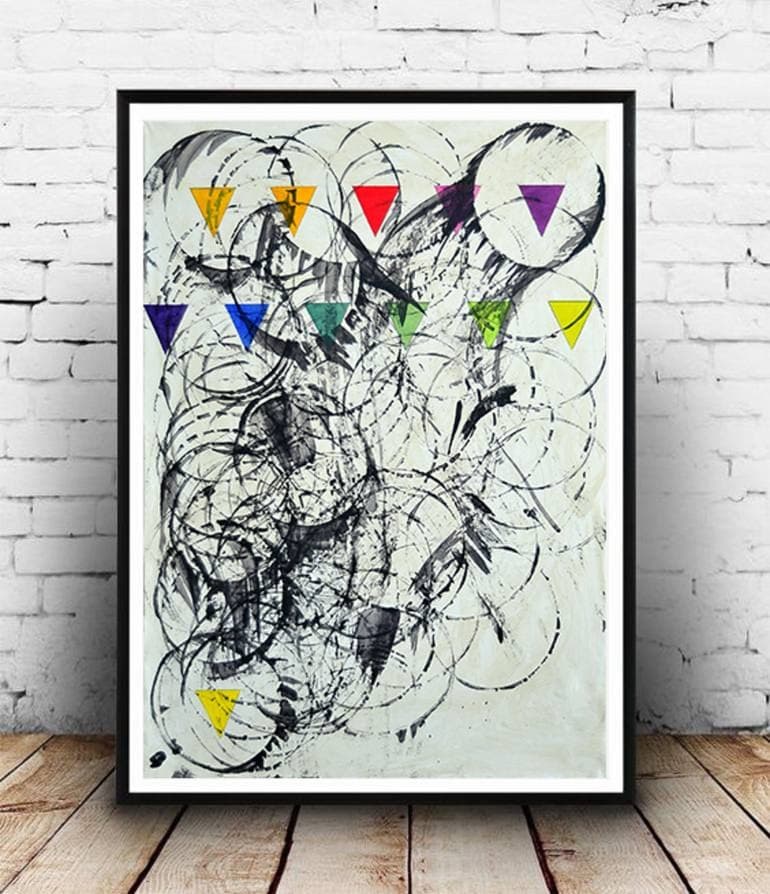
Spectrum
Twelve triangles of different colours and a scatter of circles stand for the spectrum; the artist describes every circle as a reflection of one single circle.
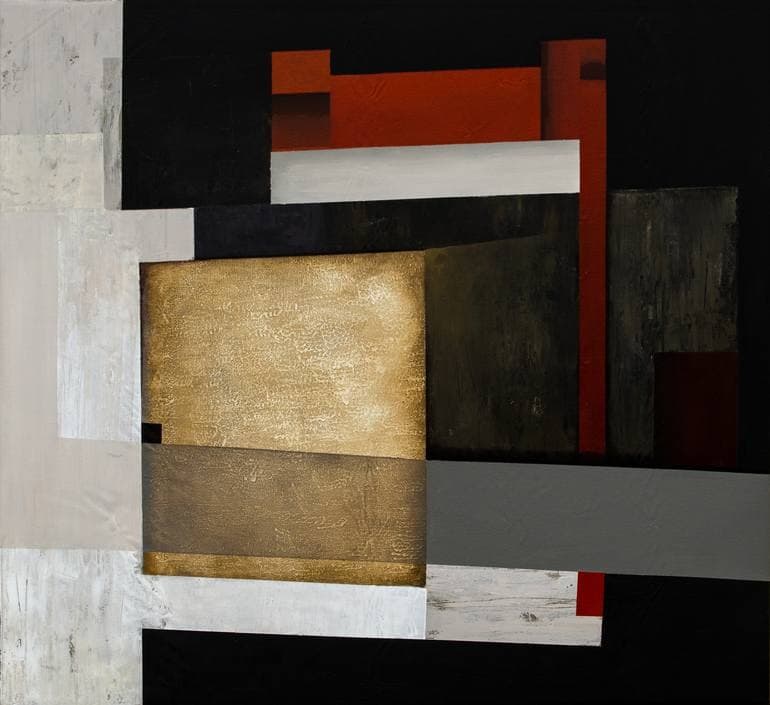
Expance
A large square abstraction in acrylic, catalogued by Saatchi Art as abstract and conceptual. Only a print edition is currently offered; the original measures 100 × 100 cm.
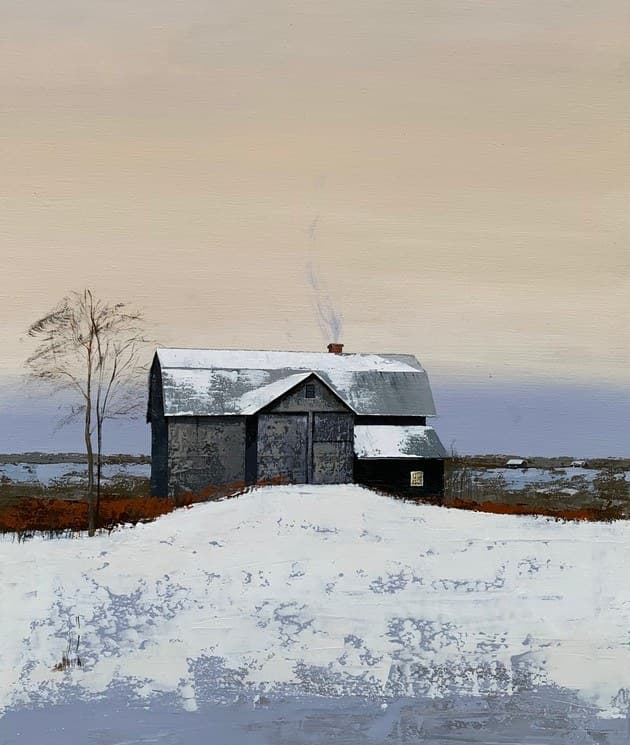
Snowy Roof
A winter view of a village roof under snow, characteristic of the quiet, meditative rural architecture that dominates Shymchyts's recent landscape work.
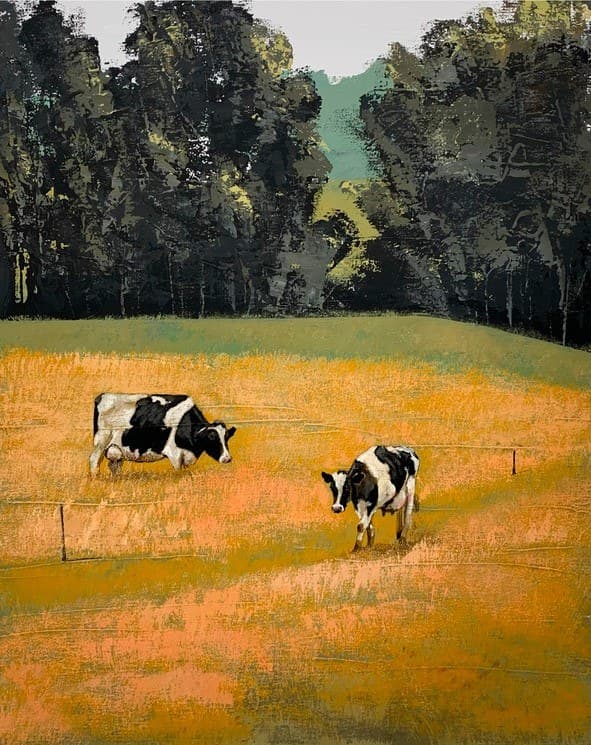
Landscape with Cows on the Field
A pastoral scene built on contrast, pairing vibrant golden fields against deep shadowy greens, with subtle gradients used to carry the natural light.