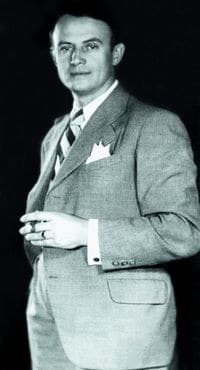
Adalbert Erdeli
Адальберт Ерделі
1891–1955 · Zahattia (Klymovytsia), Irshava district, Transcarpathia, Austria-Hungary (now Zakarpattia Oblast, Ukraine)
Adalbert Erdeli (1891–1955) was a founder of the Transcarpathian school of painting, trained in Budapest, Munich and Paris, where he absorbed impressionism and fauvism. With Yosyp Bokshai he founded the Uzhhorod art school in 1927 and taught most of the region's leading painters, refusing socialist realism throughout the Soviet period.
Adalbert Mykhailovych Erdeli was born Ivan (Beila) Hryts on 25 May 1891 in the village of Zahattia in the Irshava district of Transcarpathia, then part of Austria-Hungary; his father was the Ukrainian Mykhailo Hryts, his mother the German Ilona Tsaiska, and the family name was changed to the Hungarian 'Erdeli' — meaning 'of the forest' — when he was ten. He studied at the Budapest Academy of Fine Arts from 1911 to 1915, worked in the Kecskemét artists' colony, lived in Mukachevo from 1916, then spent 1922 to 1926 in Munich before settling in Uzhhorod. In 1927 he and Yosyp Bokshai opened the Uzhhorod Public School of Drawing, the seed of all later art education in the region, and in 1931 he founded the Society of Fine Arts Figures in Subcarpathian Rus. From 1929 to 1931 he lived in Paris, exhibiting in the same circles as Derain, Bonnard, Dufy and Matisse, and returned committed to Cézanne, whose follower he called himself under the motto 'art and love'. He chose Transcarpathia over an international career, and by the mid-1930s had painted more than a thousand pictures — landscapes, portraits and still lifes built on bold, unexpected colour, including the glass-and-water still lifes that became a signature. From 1945 to 1955 he was the first director of the Uzhhorod School of Applied Arts, and in 1946 the first chairman of the Transcarpathian branch of the artists' union; he taught Volodymyr Mykyta, Andrii Kotska, Adalbert Boretskyi, Ernest Kontratovych, Vasyl Habda and many others. He never adopted socialist realism and was denounced for formalism and bourgeois aesthetics; only after Stalin admired the dancer Klara Baloh, whose portrait Erdeli painted in 1951, was he rehabilitated enough to be allowed a solo exhibition in Uzhhorod in 1954. He died on 19 September 1955 and is buried in the Kalvaria cemetery in Uzhhorod. His estate is scattered across many countries and private collections, and in 2004 forty-eight of his paintings were stolen from his widow's house in a robbery that has never been solved.
Art Movements
Post-Impressionism
Post-Impressionism (c. 1886–1905) was a French art movement that reacted against the limitations of Impressionism, favoring emotional expression, symbolic content, and structural order over realistic light depiction. Key artists included Cézanne, Van Gogh, Gauguin, and Seurat, who used vivid, unnatural colors and thick paint application to create unique styles that paved the way for modern art. Key Characteristics Symbolic and Emotional Content: Pushing beyond the objective recording of nature to express subjective emotions and symbolic meaning. Structural Order: A move away from fleeting moments toward, as Paul Cézanne aimed, making of Impressionism "something solid and durable, like the art of the museums". Vivid, Non-Naturalistic Color: Using color for emotional or decorative impact rather than just representing natural light. Distinctive Techniques: Examples include Seurat's Pointillism (tiny, systematic dots of color) and Van Gogh's expressive, swirling brushwork.
Explore movement →Modernism
Modernism was a radical, early-to-mid-20th-century cultural movement that broke with traditional artistic, literary, and social forms to align with a rapidly industrializing world. Characterized by experimentation, abstraction, and individualism, it sought new modes of expression to address themes of alienation and social change following World War I. Rejection of Tradition: Modernists rejected Victorian morality, academic art, and realistic depictions of subjects, seeking to "make it new". Experimentation: A shift towards abstraction in art (e.g., Cubism) and new techniques in literature, such as stream of consciousness (e.g., Virginia Woolf, James Joyce). Key Themes: Focused on subjectivity, alienation, the fragmentation of reality, and the quest for new meaning. Architecture & Design: Marked by minimalism, functionalism, and the use of industrial materials, famously summarized by Le Corbusier’s "a building is a machine for living in". Time Period: Roughly 1890s–1960s, emerging in Europe and America as a response to urbanization and technological advances.
Explore movement →1905 – presentExpressionism
A modernist approach that distorts colour, drawing and surface to convey inner emotional and spiritual states rather than optical appearances. In Ukrainian art it runs from the early-twentieth-century Galician and Lviv painters through to post-war diaspora artists, who combined heavy impasto, near-abstract structural drawing and saturated non-naturalistic colour.
Explore movement →Transcarpathian School of Painting
Explore movement →Works by Adalbert Erdeli
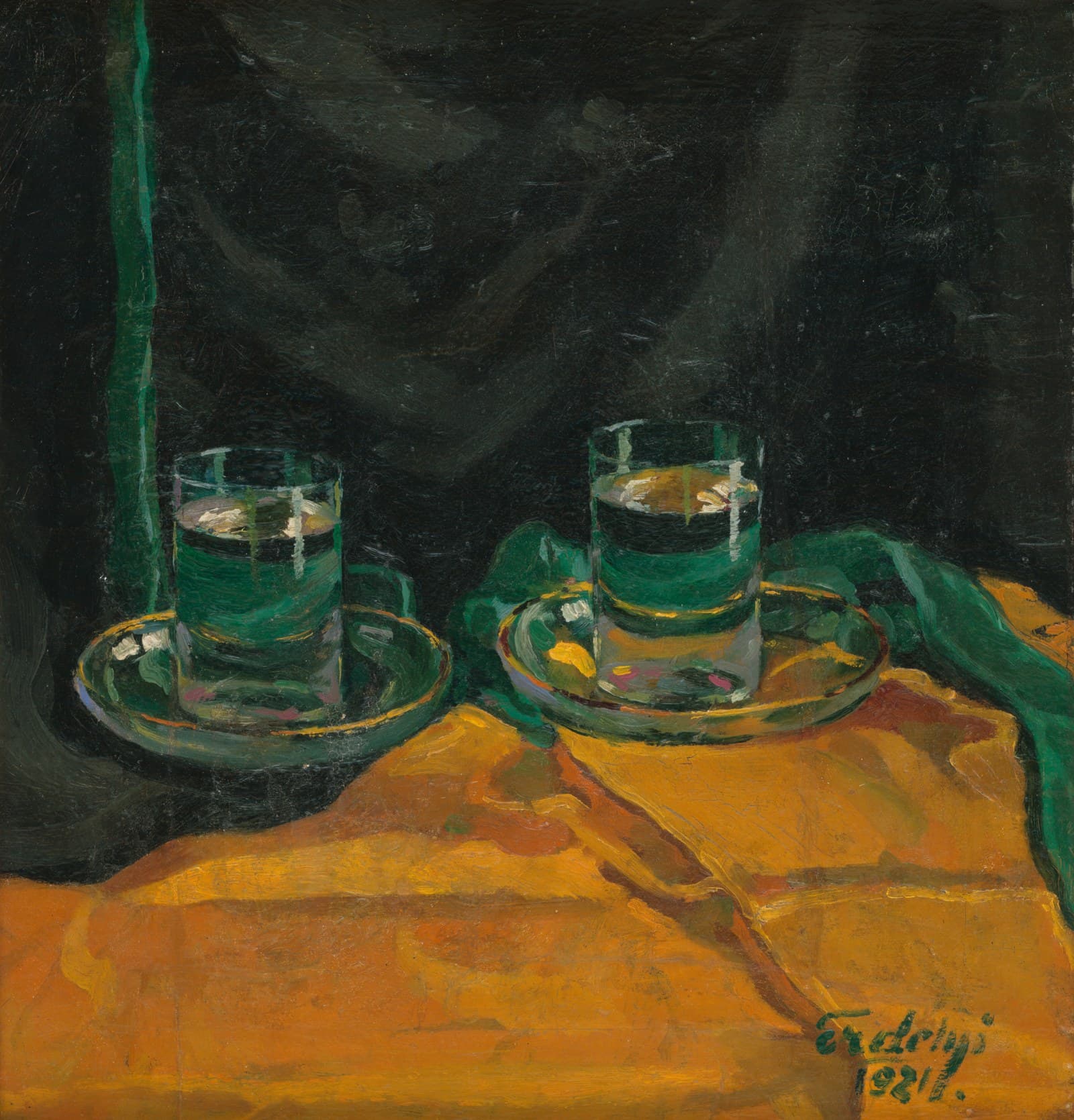
Glasses of Water
One of Erdeli's signature still lifes, tackling the notoriously difficult subject of water in clear glass. Ukrainian Wikipedia uses it as a key illustration of his early work.
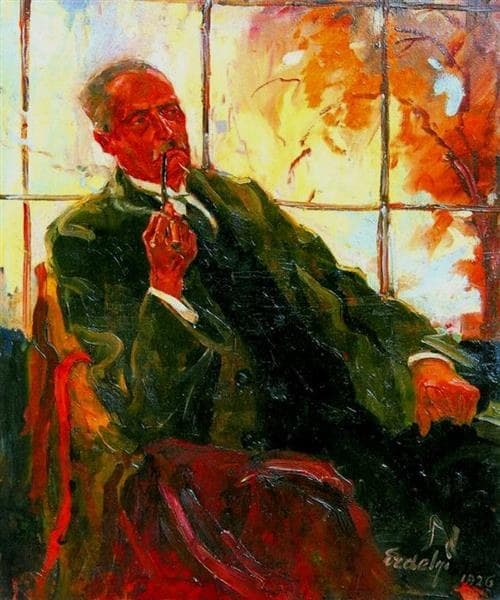
Portrait of the Artist's Father
A portrait of Mykhailo Hryts, the artist's Ukrainian father — the man who Magyarised the family name — painted in 1926, the year Erdeli settled in Uzhhorod.
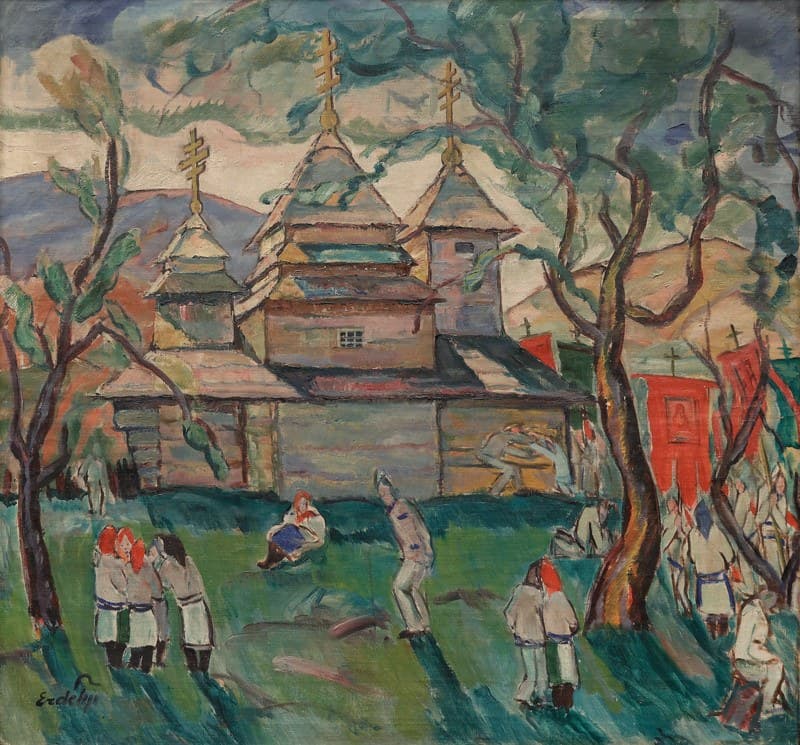
Pilgrimage to Uzhok
A large canvas of a pilgrimage in the Carpathian village of Uzhok, dated by Commons to the 1920s. Ukrainian Wikipedia captions it circa 1930.